
Google引入JavaScript驱动的SERPs以防止滥用,影响SEO、关键词研究及AI模型。其AI搜索结合NLP、BERT等技术改变电商运营方式。 2025-9-16 06:21:41 Author: securityboulevard.com(查看原文) 阅读量:15 收藏
This shift began last month, with Google indicating the move aims to protect its services from bots and potential abuse. These changes complicate search engine optimization regarding rank tracking, keyword research, and AI visibility. 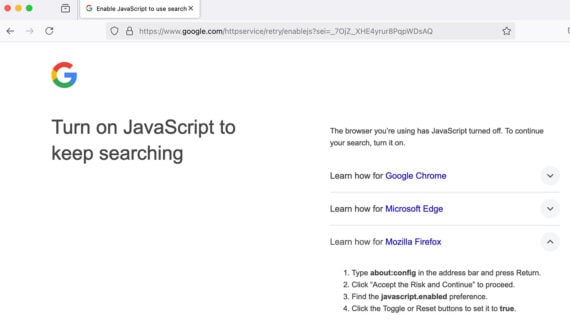 Image courtesy of Practical Ecommerce
Impact of JavaScript
Web crawlers can scrape and index JavaScript-enabled pages even when the JavaScript renders the content. For example, Googlebot can handle this complexity. The crawling process can be detailed as follows:
- Request: The crawler sends a simple HTTP GET request to the URL.
- Response: The server returns basic HTML content.
- Execute: The crawler renders the page in a headless browser like Puppeteer or Selenium to load dynamic content.
- Wait: The crawler waits for the page to load, which can slow down the process.
- Parse: The crawler parses both dynamic and static HTML.
- Use: The content is stored or utilized.
The additional steps of execution and waiting require significantly more resources, as JavaScript-enabled crawling can demand three to ten times more computing power than scraping static HTML.

| Feature | HTML Scraping | JavaScript Scraping |
|---|---|---|
| Initial response | Full HTML content | Minimal HTML with placeholders |
| JavaScript execution | Not required | Required |
| Tools | Requests, BeautifulSoup, Scrapy | Puppeteer, Playwright, Selenium |
| Performance | Faster, lightweight | Slower, resource-heavy |
| Content availability | Static content only | Both static and dynamic content |
| Complexity | Low | High |
Google does not render the entire SERP with JavaScript; it requires visitor browsers to enable JavaScript, which has a similar impact.
Rank Tracking
Marketers utilize organic rank-tracking tools to monitor web pages' positions on Google SERPs. Tools like Semrush and Ahrefs, which crawl millions of SERPs monthly, face increased costs and complexity due to this JavaScript requirement.
Keyword Research
The JavaScript requirement may also affect keyword research, making it harder to identify relevant keywords. Marketers might need to explore different ways to identify content topics if keyword data becomes unreliable.
AI Models
AI models that previously scraped Google results may face difficulties with the new JavaScript-driven pages. As AI crawlers cannot render JavaScript, they will require more time and resources to parse results, reshaping AI-driven strategies for marketers.
Google’s JavaScript Warning & AI Search
Google has issued warnings regarding excessive JavaScript use, highlighting potential blind spots for AI search crawlers. Over-reliance on JavaScript limits site visibility, as many AI crawlers struggle to read JavaScript.
The JavaScript Spectrum
Martin Splitt from Google elaborated on the balance between traditional websites and web applications, emphasizing the necessity of careful JavaScript usage. He indicated that the excitement around JavaScript can lead to its overuse, which may not be practical for every element of a website.
Recommendations for Developers
Developers should consider:
- Server-Side Rendering (SSR): Since AI crawlers cannot execute client-side JavaScript, SSR is essential for content visibility.
- Content Accessibility: Major AI crawlers prefer HTML content over JavaScript-rendered data.
- New Development Approach: Rethink "JavaScript-first" strategies to ensure proper accessibility for AI crawlers.
The Impact of Google’s AI Search on eCommerce Businesses
With over 8.5 billion searches daily, Google’s AI search is reshaping how eCommerce businesses operate. It employs techniques like natural language processing (NLP) and machine learning to deliver personalized results. 
How Google's AI Search Works
Google's AI search utilizes:
- Natural Language Processing (NLP): Enhances understanding of user queries beyond mere keywords.
- BERT: Improves context understanding, particularly for longer queries.
- RankBrain: Adjusts rankings based on user interaction with search results.
- Knowledge Graph: Analyzes real-world entity connections to enhance results.
- Discover: Provides personalized recommendations based on user interests.
Challenges and Benefits of Google’s AI Search
While Google’s AI search presents challenges such as increased competition and evolving algorithms, it also offers significant benefits.
Challenges
- Increased competition with more relevant results.
- Constantly changing algorithms that require continuous adaptation.
- Rising expectations for high-quality content.
Benefits
- The potential to reach new audiences through AI-driven recommendations.
- Opportunities for creating engaging, valuable content.
- Enhanced trust and loyalty through consistent quality.
Adapting to Thrive with Google's AI Search
To succeed in the evolving landscape shaped by Google’s AI search, eCommerce businesses should:
- Leverage analytics tools to understand user behavior.
- Use structured data and schema markup to enhance content visibility.
- Create valuable, optimized content that answers user queries.
- Optimize for mobile and voice search to cater to diverse user preferences.
- Diversify revenue streams by offering complementary products or services.
- Continuously test and measure performance to enhance strategies.
- Stay updated with the latest trends and best practices in SEO.
For developers and eCommerce businesses, adapting to the changes brought by Google’s AI search is crucial for maintaining competitive advantage and ensuring user satisfaction. Explore how Mojoauth can help integrate passwordless authentication solutions, enhance user adoption strategies, and provide customer support services to create a smooth, secure login experience for your applications. Contact us today to learn more about our services.
*** This is a Security Bloggers Network syndicated blog from MojoAuth - Advanced Authentication & Identity Solutions authored by MojoAuth - Advanced Authentication & Identity Solutions. Read the original post at: https://mojoauth.com/blog/the-impact-of-googles-javascript-serps-and-ai-search-on-ecommerce-businesses
如有侵权请联系:admin#unsafe.sh