好的,我现在需要帮用户总结一篇文章的内容,控制在100字以内,而且不需要特定的开头。首先,我得仔细阅读文章,理解其主要内容。 文章主要讲的是“尾随攻击”(Piggybacking)对组织安全构成的威胁。这种攻击方式是通过跟随授权人员进入受限制区域,绕过物理安全措施。虽然听起来像是简单的跟随,但实际危害很大,可能导致未经授权的访问和数据泄露。 接下来,我需要确定关键点:尾随攻击的定义、它如何绕过安全措施、可能带来的风险(如访问敏感区域、数据盗窃等),以及防范措施。这些信息需要简洁明了地表达出来。 然后,我要确保语言简洁,不超过100字。可能的结构是先点明主题,再说明问题和影响,最后提到防范方法。 最后检查一下是否符合用户的要求:中文总结,不使用特定开头语句,控制在100字以内。确保没有遗漏重要信息,并且表达清晰。 </think> 文章探讨了尾随攻击(Piggybacking)这一物理安全威胁,指出其通过跟随授权人员进入受限区域绕过安全措施的风险。这种攻击可导致未经授权的访问、数据泄露及内部网络威胁。防范需结合物理安全控制、持续监控及员工安全意识提升。 2026-3-10 06:30:21 Author: securityboulevard.com(查看原文) 阅读量:8 收藏
Organizations invest heavily in advanced cybersecurity technologies such as endpoint detection, identity access management, zero trust architecture, and continuous monitoring. However, a significant number of security incidents still originate from physical security weaknesses rather than purely digital vulnerabilities. Such often overlooked threats are piggybacking attacks.
It is a social engineering and physical access attack technique where an unauthorized individual gains entry into a restricted area by following an authorized person through a secured access point. While it may appear harmless or accidental, piggybacking attacks can create serious security risks for organizations by allowing attackers to bypass authentication controls and gain direct access to sensitive systems, networks, and data.
Closely related to piggybacking attacks is tailgating, a technique where attackers deliberately follow an authorized individual into secured premises without proper authentication. Although the terms are sometimes used interchangeably, piggybacking usually involves some level of implicit permission from the authorized person, whereas tailgating is typically more deceptive.
Piggybacking: A Hidden Organizational Security Threat
This represents a critical physical security risk that allows unauthorized individuals to bypass organizational access controls and enter restricted environments without proper authentication.
- Exploiting Behavioral Patterns Instead of Technical Vulnerabilities
Piggybacking attacks primarily rely on exploiting human behavior and routine access patterns rather than directly breaking technical security mechanisms. Instead of attempting to hack access control systems, attackers leverage natural entry points created during legitimate access events.
- Circumventing Physical Access Control Systems
Organizations often deploy strong access control technologies such as RFID badges, biometric scanners, and smart card authentication to secure critical facilities like corporate offices, data centers, and research labs. Piggybacking attacks allow attackers to bypass these systems entirely by entering through the same authentication event as an authorized individual.
- Breaching the Organizational Security Perimeter
When a piggybacking attack occurs, attackers effectively cross the organization’s physical security boundary without triggering alarms or access logs. This creates a silent breach where the attacker is already inside the trusted environment before any security monitoring mechanisms can detect suspicious activity.
- Gaining Trusted Physical Presence Within the Environment
Once inside, attackers operate within the same physical space as legitimate personnel and infrastructure. This proximity enables potential access to internal systems, workstations, network ports, and sensitive areas that are typically protected from external threats.
Breaking Down the Security Breach Tactics
| Aspect | Piggybacking | Tailgating |
| Definition | A physical security breach where an unauthorized individual gains access to a restricted area by leveraging a legitimate authentication event, typically through implicit or explicit assistance from an authorized person. | A physical intrusion technique where an attacker closely follows an authorized individual through a secured access point without undergoing independent authentication. |
| User Awareness | The authorized individual may knowingly or unknowingly permit the additional entry during the same access control event. | The authorized individual is generally unaware that an attacker has entered immediately behind them. |
| Interaction Level | Often involves social engineering tactics such as requesting access, claiming credential issues, or impersonating legitimate personnel. | Typically involves minimal or no interaction, relying instead on timing and physical proximity. |
| Attack Technique | Combines physical access exploitation with social engineering to bypass authentication mechanisms embedded in physical access control systems. | Exploits gaps in access control enforcement, allowing entry before the secured door or access barrier resets. |
| Operational Scenario | Occurs when a single authentication event (e.g., badge scan or biometric verification) unintentionally permits multiple individuals to enter a controlled zone. | Occurs when an attacker quickly follows an authenticated individual through a controlled entry point before it closes or resets. |
| Attack Characteristics | More socially engineered and manipulation-driven, exploiting trust and organizational behavioral patterns. | More opportunistic and stealth-oriented, relying on rapid movement and lack of monitoring at entry points. |
| Security Impact | Enables unauthorized presence within controlled environments, potentially leading to access to internal systems, sensitive infrastructure, or restricted operational zones. | Allows attackers to bypass physical authentication checkpoints, creating an entry point for further reconnaissance or internal compromise activities. |
How Piggybacking Attack Works?
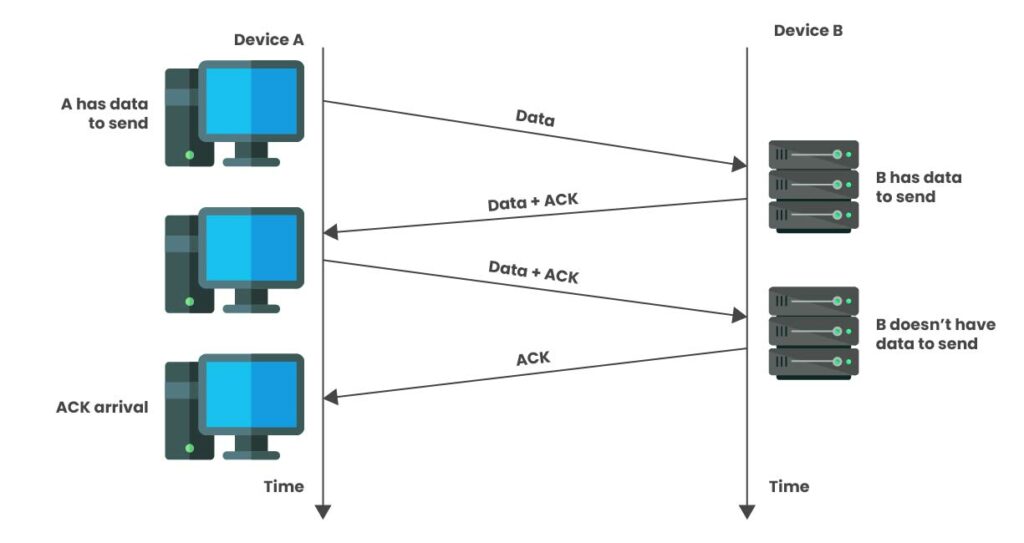
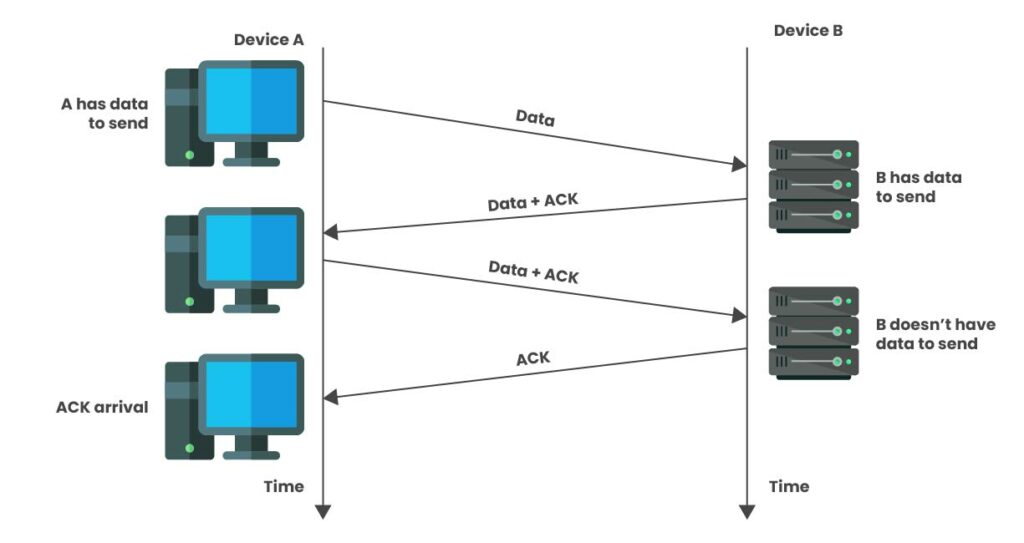
- A client device (such as a computer or mobile device) initiates communication with another device over a network using a protocol like TCP.
- The server divides the information into smaller packets, each containing a header and a payload, and sends them to the client.
- When the client receives a packet, it sends an acknowledgement (ACK) back to the server to confirm successful receipt.
- With piggybacking, the client can attach additional data to the ACK packet instead of sending a separate packet.
- This additional information may include another data segment, a request for more data, or other relevant communication.
- The server then processes the ACK along with the attached data.
- By combining acknowledgements with data transmission, this reduces the number of packets sent, improving network efficiency and lowering latency.
Why Piggybacking Is a Serious Security Risk?
Many organizations underestimate the impact of piggybacking security risk because it does not initially involve malware or network exploitation. However, once attackers gain physical access, the security implications become significant.
- Unauthorized Access to Critical Infrastructure
Piggybacking attacks can allow attackers to enter restricted areas, such as:
- Server rooms
- Network operation centers
- Research and development labs
- Security control rooms
These locations contain critical systems that support enterprise operations. Physical access can enable attackers to connect rogue devices, install hardware implants, or directly manipulate systems.
- Data Theft and Intellectual Property Exposure
Once inside the organization’s physical environment, attackers may gain access to unattended workstations, sensitive documents, or internal storage devices. In many cases, computers are left unlocked for short periods, creating opportunities for attackers to extract data.
Sensitive information that can be compromised includes:
- Customer data
- Intellectual property
- Source code repositories
- Financial records
- Internal communications
Because the bypasses perimeter controls, the resulting breach may not immediately trigger cybersecurity alerts.
- Insider Threat Simulation
The threat essentially allows an external attacker to behave like an insider threat. Security systems often trust internal network activity more than external traffic.
Once attackers are physically present within the organization, they may:
- Connect directly to internal network ports
- Install rogue wireless access points
- Deploy malicious USB devices
- Conduct lateral movement within the network
These actions significantly increase the attacker’s ability to escalate privileges and compromise multiple systems.
How Kratikal Can Prevent Piggybacking Threats?
Preventing piggybacking attacks requires a combination of strong physical security controls, continuous monitoring, and organizational security awareness. Kratikal helps organizations mitigate risks by implementing comprehensive security assessments, advanced access control evaluations, and security awareness programs designed to identify gaps in physical and cyber security frameworks. Through VAPT engagements, security architecture reviews, and risk advisory services, Kratikal assesses whether restricted environments such as offices, data centers, and critical infrastructure zones are vulnerable to unauthorized access attempts. Additionally, Kratikal enables organizations to strengthen their defenses by recommending identity-aware access controls, surveillance monitoring, visitor management systems, and Zero Trust security practices.
FAQs
- How does TCP use piggybacking?
Using TCP (Transmission Control Protocol), piggybacking enables acknowledgment messages to be combined with data packets, minimizing overhead and improving communication efficiency. This technique can lead to faster and smoother application performance.
- What is the difference between ACK and piggyback?
Piggybacking is a method in which the receiver postpones sending an acknowledgment (ACK) and combines it with its next outgoing data packet. This approach reduces the number of separate control frames, enhancing overall network efficiency.
- What is an example of piggybacking?
Piggybacking refers to situations where an individual gains access or benefits by taking advantage of another person’s authorized access or resources. For example, someone might enter a concert venue by closely following a ticket holder through the entrance, bypassing the security check without having a valid ticket.
- What is the purpose of piggybacking?
Piggybacking minimizes the number of packets required for data transmission, thereby reducing network overhead. By combining data with acknowledgment messages, it decreases the total number of packets exchanged across the network. This approach improves overall efficiency, resulting in lower latency and enhanced performance.
- Is there piggybacking in HTTP?
Piggybacking is not typically used in HTTP itself. However, it can occur at the transport layer in protocols like TCP, where acknowledgment packets are combined with outgoing data to improve communication efficiency.
The post How Piggybacking Attacks Threaten Organizational Security? appeared first on Kratikal Blogs.
*** This is a Security Bloggers Network syndicated blog from Kratikal Blogs authored by Shikha Dhingra. Read the original post at: https://kratikal.com/blog/piggybacking-attacks-threaten-organizational-security/
如有侵权请联系:admin#unsafe.sh