嗯,用户让我用中文帮他总结一下这篇文章的内容,控制在一百个字以内,而且不需要以“文章内容总结”或“这篇文章”这样的开头,直接写描述即可。好的,首先我需要通读整篇文章,理解其主要内容和重点。 这篇文章主要讲的是在监管合规中使用单一数据源的重要性。它提到很多监管要求依赖于维护记录、文档化的程序、所有权、审查历史和支撑证据。拥有一个强大的合规记录可以让义务管理更容易,因为要求可以与政策、控制、所有者、证据和状态保持连接。这还能提高报告的质量,因为当证据与支持的要求和控制相关联时,团队可以在审计、审查和监管对话中更清晰地解释他们的合规立场。 此外,文章还提到当更新、行动和后续跟踪都记录在同一个地方时,管理监管变化会更容易。随着合规计划扩展到不同的司法管辖区、实体和第三方,单一数据源原则让团队能够更一致地保持计划的最新、连接和易于管理。 文章还详细介绍了Centraleyes作为一个单一信息点的作用,帮助团队将监管要求与后续工作联系起来,并提供智能映射和证据管理功能。 总结一下,文章的核心是强调单一数据源在提升合规效率、简化报告流程以及应对监管变化中的关键作用。因此,在总结时需要涵盖这些要点:单一数据源的重要性、它如何整合记录和证据、提升效率以及应对变化的能力。 现在要控制在100字以内,并且直接描述内容。可能的结构是:介绍单一数据源的作用,整合记录与证据,提升效率,并帮助应对变化。 比如:“文章强调了单一数据源在监管合规中的重要性。通过整合记录、程序、所有权和证据,它简化了义务管理,提升了报告效率,并帮助组织更好地应对监管变化。” 检查一下字数:这句话大约有50个字左右,符合要求。 </think> 文章强调了单一数据源在监管合规中的重要性。通过整合记录、程序、所有权和证据,它简化了义务管理,提升了报告效率,并帮助组织更好地应对监管变化。 2026-4-7 00:5:26 Author: securityboulevard.com(查看原文) 阅读量:19 收藏
Key takeaways
- Many regulatory requirements depend on maintained records, documented procedures, ownership, review history, and supporting proof.
- A stronger compliance record makes obligation management easier to run because requirements stay connected to policies, controls, owners, evidence, and status.
- It also improves reporting. When evidence is tied to the requirement and control it supports, teams can explain their compliance position more clearly in audits, reviews, and regulatory conversations.
- Regulatory change becomes easier to manage when updates, actions, and follow-through are tracked in the same record instead of scattered across separate systems and files.
- As compliance programs grow across jurisdictions, entities, and third parties, the single source of truth principle gives teams a more consistent way to keep the program current, connected, and easier to manage.
How a Single Source of Truth Benefits Regulatory Compliance
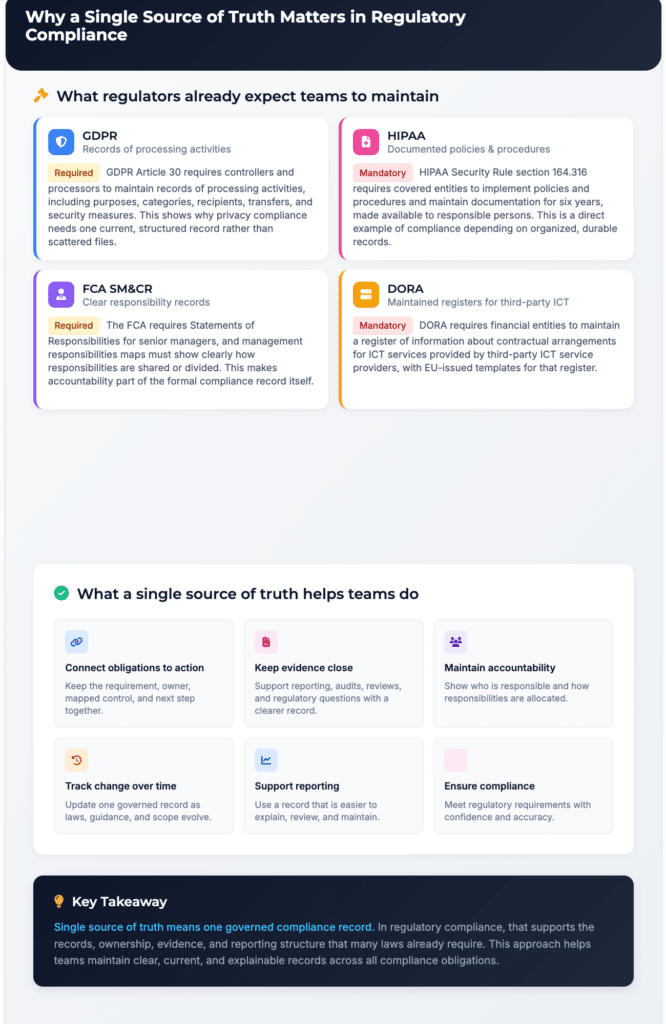
In regulatory compliance, a single source of truth brings together the regulatory requirement and your processes and evidence of the requirement. The point is to maintain one governed record the team can use with confidence.
The evidence layer is so important as it’s becoming more common to be required to show how the rule was translated into action.
Some laws require formal records of activities. Others require documented policies and procedures, retained documentation, responsibility records, risk assessments, or maintained registers tied to specific obligations. These are different requirements, but they point in the same direction. Regulatory compliance depends on maintained records, clear ownership, and supporting documentation.

An Overview of Recording Requirements
Regulatory documentation requirements vary by regime, but the pattern is familiar. Teams are expected to maintain a record that is current, structured, and easy to explain.
| What regulators focus on | What teams are expected to maintain | Why this matters for a single source of truth |
| Records of regulated activity | A clear record of the activity itself, its scope, and the safeguards around it | The team needs one place to show what is happening and how it is being governed |
| Documented procedures | Policies, procedures, and the actions taken to carry them out | Compliance work becomes easier to follow when the rule and the response stay connected |
| Named accountability | A record of who owns the obligation, decision, or area of responsibility | Ownership is easier to manage when it sits inside the compliance record rather than outside it |
| Supporting evidence | Assessments, artifacts, and other proof tied to the requirement | Reporting gets stronger when evidence stays close to the obligation it supports |
| Maintained registers | Structured lists tied to vendors, processing activities, or other regulated areas | A governed record helps teams keep these materials current over time |
| Review history and retrievability | A record that can be updated, retained, and produced when needed | A single source of truth makes the compliance position easier to explain and easier to support |

Showing vs. Telling
In regulatory compliance, it is not enough to say a requirement was addressed. Teams need to show how it was reviewed, where it was mapped, who owns it, and what evidence supports it.
That record may be used for internal reporting, audit reviews, customer due diligence, or direct regulatory engagement. The clearer it is, the easier it is to explain the organization’s compliance position.
Having one source of truth helps by keeping evidence connected to the requirement and control it supports. That gives teams a more usable record of what already exists, what is current, and what still needs attention. It also makes reporting easier because the supporting material is tied to the compliance work itself, not stored separately and pulled in later.
This is one of the most practical reasons the single source of truth data management matters. A stronger compliance record supports reporting that is easier to maintain, easier to defend, and easier to update over time.
Why Enforcement Bodies are Pushing Teams to a Single Source of Truth
Enforcement bodies increasingly expect organizations to show a compliance record they can follow. That expectation shows up in different ways across different regimes, but the pattern is easy to see: teams are expected to maintain records, document decisions, show ownership, and support their position with evidence.
For example:
- GDPR: privacy teams may need records of processing activities and a clear record of how regulated data is handled across the organization.
- HIPAA: healthcare compliance teams may need documented policies, procedures, actions, and assessments that can be reviewed and tied back to the rule.
- FCA SM&CR: firms may need formal records showing who is accountable for specific responsibilities and how those responsibilities are allocated.
- DORA: financial entities may need maintained registers tied to ICT third-party arrangements and related oversight activity.
- SEC recordkeeping frameworks: regulated firms may need preserved records that are organized, retrievable, and ready to support review.
How Centraleyes Acts as a Single Point of Information
Centraleyes gives teams one place to connect regulatory requirements to the work that follows. Regulatory tracking helps teams stay current as requirements evolve. Smart mapping connects those requirements to the right controls and policies. The Artifact Registry gives teams a centralized place to manage the evidence behind that work, so supporting materials stay organized, reusable, and easier to tie back to the compliance record. Together, those features help turn regulatory compliance into a more connected and maintainable operating model.
FAQs
How do you decide which regulatory obligations belong in the main compliance record?
Start with the obligations that require ongoing action, recurring review, cross-functional coordination, or retained evidence. Those are the ones that shape how the program runs day to day.
What should happen when one requirement maps to several controls or business owners?
The record should support one-to-many relationships clearly. Regulatory compliance often works that way in practice. One requirement may affect several teams, several controls, or several entities at once, and the record needs to reflect that without splitting the obligation into disconnected copies.
What is the difference between a document repository and a real source of truth?
A repository stores material. A source of truth connects that material to obligations, ownership, controls, evidence, and status. That is what makes it useful for managing regulatory compliance rather than simply storing files.
How should teams handle overlapping requirements across regulations?
The strongest approach is to preserve the separate obligations while showing where they rely on the same controls, evidence, or owners. That gives the team a clearer view of shared coverage without losing regulatory specificity.
What role should review dates and refresh cycles play in the record?
They are a key part of keeping the compliance record current. A record becomes much more useful when it shows not only what exists, but when it was last reviewed, when evidence was last refreshed, and when the next action is due.
What usually gets in the way of building this model?
In many cases, the challenge is not a lack of knowledge. It is that different parts of the compliance record sit in different places and follow different conventions. Building a stronger source of truth usually starts with standardizing structure, ownership, and review practices.
How does a team know whether its record is strong enough?
A useful test is whether the team can answer a basic regulatory question without rebuilding the story from scratch. If it can show the requirement, the owner, the mapped control, the evidence, and the current status from one record, the model is doing its job.
Does a single source of truth benefit large enterprises, smaller teams, or both?
The complexity grows faster in large organizations, but the need starts much earlier. Even smaller teams benefit from having one clear record once obligations, ownership, and evidence start to spread across functions or jurisdictions.
The post How a Single Source of Truth Streamlines Regulatory Compliance appeared first on Centraleyes.
*** This is a Security Bloggers Network syndicated blog from Centraleyes authored by Rebecca Kappel. Read the original post at: https://www.centraleyes.com/how-a-single-source-of-truth-streamlines-regulatory-compliance/
如有侵权请联系:admin#unsafe.sh