
In the last two MDR posts, I looked at how MDR has to move beyond alert triage. Fi 2026-5-27 20:21:4 Author: raffy.ch(查看原文) 阅读量:17 收藏
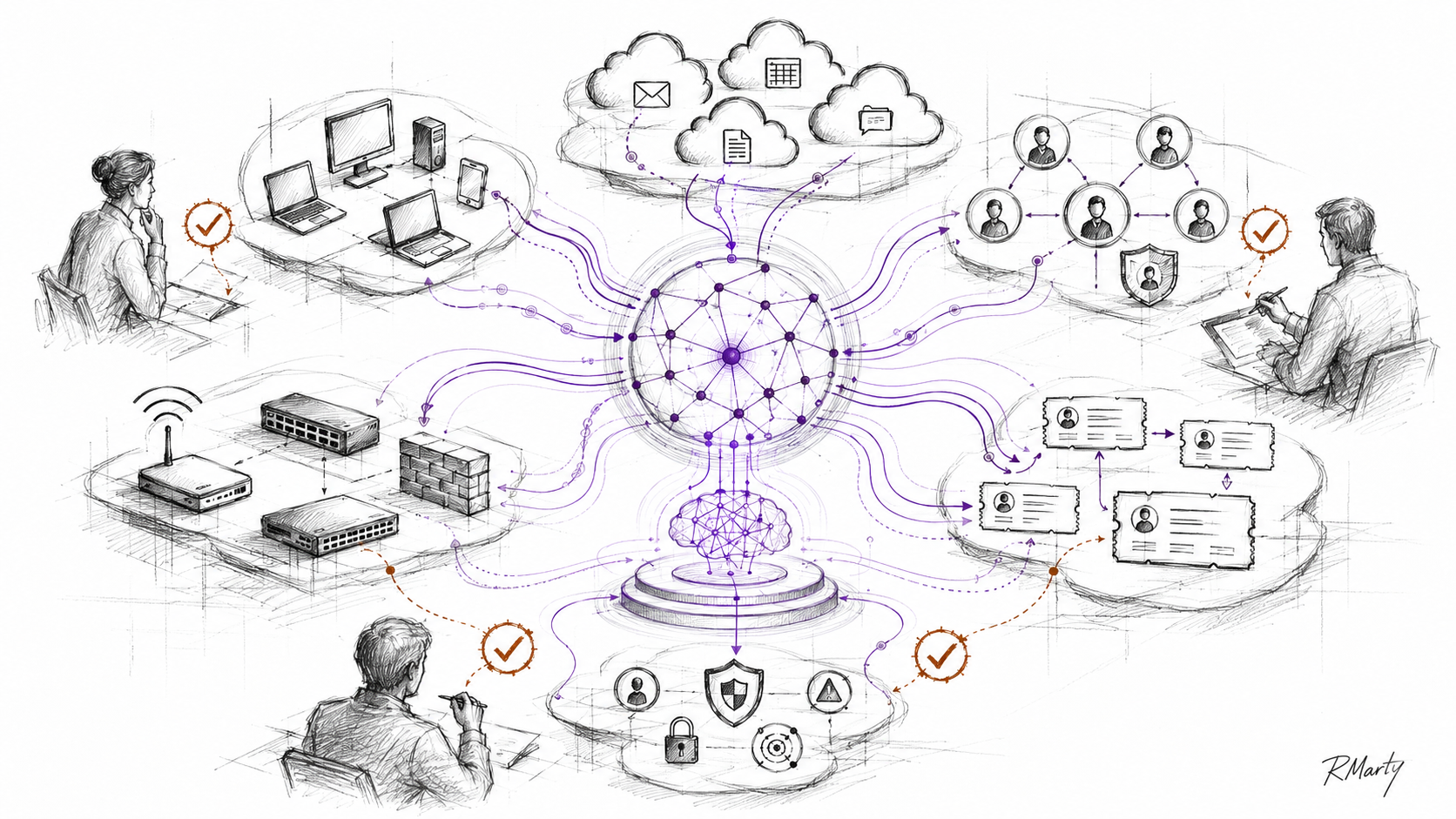
In the last two MDR posts, I looked at how MDR has to move beyond alert triage. First, the natural MDR extensions: asset and control coverage, exposure management, SIEM and data quality, cloud and identity posture, response orchestration, and proof that risk actually went down. Then, the deeper architecture: next-gen MDR as an AI-native SecOps control plane, where services become more productized, SIEM becomes symbiotic, and detection has to move into governed response.
This post is the next layer out.
Most conversations around AI in the MSP ecosystem still focus on copilots, workflow automation, and operational efficiency. Those are important, but they miss the larger transition underway. AI is forcing a redesign of the operational infrastructure underneath managed services itself, creating new platform dynamics and potentially large capital market opportunities across the SMB technology stack.
If MDR is becoming an AI-native SecOps control plane, what happens to the broader MSP market? My view is that the same operating shift is coming there too, but with a wider scope. The best MSPs will not just add AI to tickets, service desks, and support workflows. They may become the AI operations layer for SMB and mid-market infrastructure. That is a much bigger idea than “AI for MSPs.”
Services Are Becoming Software-Defined
Historically, software scaled and services did not. Services were people-heavy, exception-heavy, and hard to standardize. Good MSPs could improve process, stack discipline, and technician leverage, but the model still depended heavily on human execution.
AI changes part of that equation.
Support, remediation, governance, workflow routing, escalation, documentation, compliance evidence, and customer reporting can all become more software-defined. That does not eliminate the human operator. It changes the operator’s job from doing every step manually to designing, supervising, validating, and improving the operating loop.
This is why the boundaries between MSP, MDR, SaaS, outsourcing, and consulting start to blur. A managed service that is telemetry-driven, API-connected, AI-assisted, and outcome-accountable begins to look less like a traditional services business and more like an operating platform with humans in the loop.
MDR is one version of this. MSP is the broader version.
Copilot Is Not The End State
A lot of current AI messaging still sounds like copilot: summarize a ticket, draft a response, help an analyst investigate faster, recommend the next step, generate a report. That is useful, but it is not the final state. The customer is not really buying a better chat interface. They are trying to buy operational confidence.
For MSPs and MDR providers, the value stack is moving in this direction:
| Old Value | Transitional Value | Future Value |
|---|---|---|
| Tools | Workflows | Outcomes |
| Tickets | Orchestration | Operational continuity |
| Alerts | Investigations | Risk reduction |
| Dashboards | Recommendations | Governed action |
| Labor | Automation | Confidence with accountability |
This is where MSP and MDR converge. The customer does not want a PSA queue, RMM console, SIEM, EDR tool, dashboard, or pile of alerts. They want uptime, resilience, recoverability, compliance, secure productivity, fewer surprises, and someone accountable when the system does not behave the way it should. The product becomes operational confidence.
The Hard Part Is Operational State
This is also where a lot of “AI-first MSP” thinking is still too shallow. The hard part is not putting an LLM on top of a ticket queue. The hard part is knowing enough about the operating environment to take action safely. To automate IT and security operations, the system needs to know what exists, who owns it, what it connects to, what is business-critical, what policy applies, what telemetry is missing, what action is allowed, what could break, who can approve, how to roll back, and whether the action worked.
That requires an operational middleware layer:
| Layer | Why It Matters |
|---|---|
| Asset and identity context | The system needs to know who, what, privilege, ownership, and business impact. |
| Telemetry quality | AI cannot reason well over missing, stale, or badly shaped data. |
| Workflow routing | The platform has to know when to automate, escalate, notify, or wait. |
| Policy and authority boundaries | Automation needs clear limits on what it is allowed to do. |
| Action and rollback controls | Remediation has to be safe enough for production environments. |
| Evidence and reporting | The provider must prove what changed, not just that work was performed. |
This should sound familiar from the MDR discussion. The same architecture problems show up again: context, telemetry, workflow, policy, action, proof. The difference is that MSPs operate across a wider surface area. They touch endpoint management, identity, SaaS administration, backup, patching, compliance workflows, help desk, procurement, user onboarding, security tooling, and business continuity. That makes the AI opportunity larger, but it also makes the operating problem harder.
This is also why I am a proud advisor to FlowMind. They are tackling this problem from exactly the right angle: building a context graph across IT, network, cloud, and security knowledge, then using that context to automate ticket triage, investigation, and response. The important part is not just classifying the ticket faster. It is understanding the live customer environment well enough to recommend or execute the right fix.
AI-First MSP Is A Refounding, Not A Feature Upgrade
The phrase “AI-first MSP” can make the transition sound easier than it is. A true AI-native provider probably needs a different labor model, pricing model, knowledge system, telemetry stack, escalation chain, customer contract, operating metric set, and governance architecture. That is closer to a refounding than a modernization project.
The old MSP model optimized for human leverage: more endpoints per technician, better ticket workflows, tighter vendor standardization, and stronger recurring revenue. The next model has to optimize for governed automation: more safe actions per operator, better telemetry coverage, faster remediation loops, clearer authority boundaries, and stronger proof of outcome.
That also changes what investors and strategic acquirers should underwrite. Scale alone is not enough. Recurring revenue alone is not enough. A large MSP platform with fragmented tools, weak data architecture, inconsistent telemetry, and human-heavy workflows may not be an AI-native operating platform. It may just be a large labor organization with good retention.
The quality question becomes more operational: can this provider turn distribution, trust, and access into a compounding operating system?
The Practical Test
The test is not “does this MSP have AI?” That question is already too shallow. The better test is whether the provider can answer a few operating questions consistently:
| Question | Why It Matters |
|---|---|
| What does the provider actually know about the customer environment? | AI leverage depends on accurate asset, identity, telemetry, and business context. |
| Which actions can be automated safely? | The value is not automation volume. It is governed action without breaking the customer. |
| Where does human approval still matter? | Autopilot still needs escalation, exception handling, and accountability. |
| Can the provider prove risk or operational burden went down? | Activity reporting is not enough if the outcome is confidence. |
| Does the operating model improve with scale? | The best platforms should compound knowledge and workflow quality across customers. |
This is where diligence should move. Not just gross retention, endpoint count, technician utilization, or EBITDA margin, but whether the operating architecture is actually becoming more software-defined over time.
Distribution Is The Hidden Asset
The strongest strategic asset in the MSP market may not be the software stack. It may be the distribution layer.
MSPs already have something most AI vendors want and cannot easily build: trusted access into the SMB technology environment. They often have admin rights, endpoint access, SaaS integrations, procurement influence, business continuity responsibility, and a working relationship with the customer. That matters because SMBs generally do not have the internal capacity to manage AI transformation, AI governance, security operations, identity, SaaS posture, and workflow automation on their own. If AI agents become part of the workforce, somebody has to manage the operating environment around them. Identity, permissions, logging, workflow access, data boundaries, compliance, security, and incident response all have to extend from human employees to semi-autonomous systems.
That creates a larger role for the best MSPs and MDR providers. They can become SMB operational governance providers, not just outsourced IT or security teams.
The Market Will Not Reward Everyone
The dangerous assumption is that AI automatically increases the value of MSPs. It might. But it could also compress margins, reduce switching costs, commoditize service delivery, centralize operational intelligence in large platforms, and move value toward Microsoft, hyperscalers, or AI-native software vendors. The providers that benefit most will be the ones that turn service delivery into a software-defined operating model. The providers that only add AI features to the old model may see the opposite effect: more pricing pressure, less differentiation, and less tolerance for messy delivery. This is the broader implication of the AI-native MDR thesis. MDR may become the SecOps control plane. MSPs may become the operations and governance layer for the rest of the SMB technology stack.
The categories may keep their old names for a while: MSP, MDR, MSSP, SaaS, GSI, AI SOC. But the operating model underneath them is changing. The strategic question is no longer just who manages the tools. It is who becomes trusted to operate the customer environment as AI becomes part of the workforce.
No comments yet.
如有侵权请联系:admin#unsafe.sh