The following interview, which we publish in full, was conducted in May 2026 by me, fastfire.Th 2026-5-28 15:44:3 Author: deepdarkcti.com(查看原文) 阅读量:13 收藏
The following interview, which we publish in full, was conducted in May 2026 by me, fastfire.
The pro-Russia hacktivist collective NoName057(16) (often referred to as NoName) emerged in March 2022 following the Russian invasion of Ukraine. The group primarily conducts disruptive Distributed Denial-of-Service (DDoS) campaigns against government and private sector entities in NATO member states and other countries perceived as supporting Ukraine.
In 2025 and early 2026, NoName057(16) has shown extreme resilience, escalating its campaigns even after “Operation Eastwood” in July 2025, a multi-national effort that targeted its infrastructure.
Q (fastfire): How do you define NoName’s mission today?
A (F F): Our mission is to bring justice. We even have a slogan – “Justice has no name – NoName057(16)”.
Q (fastfire): How do you define success for an operation?
A (F F): How do you define success for an operation?
Success initially consists of the amount of resources that we put into the DDoS attack, how long they were offline, and what damage (economic and image) was inflicted on the authorities and the economy of the attacked country. We can also evaluate our attacks on camera hacking, pentest, deface, and attacks on SCADA and HMI. But the support of our activities by ordinary people around the world means much more. They see that Western aggression can and should be resisted and join us.
Q (fastfire): How are targets selected and approved?
A (F F): Listen, Western intelligence agencies and cyber experts are doing a brilliant job of this for us. You can look at the reports from European countries and see for yourselves. As a result of our cyberattacks, Germany has suffered losses amounting to €202.4 billion, Spain will spend €1.157 billion on cyber defence, and so on.
Q (fastfire): Why do many operations focus on public institutional websites rather than apparently more critical digital services? Is that a deliberate symbolic choice or a limitation of reconnaissance capacity?
A (F F): We are attacking those sites that will cause the greatest damage to the economies of countries unfriendly to Russia and to the image of corrupt European authorities. We are conducting a comprehensive analysis of the target, identifying domains that, according to the analysis results, are more likely to be successfully attacked and stop working.
Q (fastfire): Ok, so is it correct to say that you do a “load” test with DDosia before adding a hostname to the targets, to understand if that host is more prone to an attack?
A (F F): That’s not quite true. We study attack vectors against a specific target and, based on the data obtained, decide which domains and their subdomains we are attacking at the moment. In addition, we use different tactics, and if a subdomain is not included in the first list of targets, it may be under attack during the next iteration. The process of conducting an attack is an art form. We are not scriptkids, who have entered a list of urls into the commercial stressor panel and, after dropping one of the sites for 1 second, run to write a post in their telegram channel that they carried out a powerful cyberattack on a very complex resource, despite the fact that it was a resource of a rural bathhouse in a small Italian province, which was visited only by the owner of this bathhouse and his three alcoholic friends.

Q (fastfire): If you notice that a host you are analyzing is protected by an anti-ddos layer such as Cloudflare, does this have an impact on your choice of targets?
A (F F): We have repeatedly and persistently attacked the resources protected by the service you specified.
Q (fastfire): How is the group organized internally? What roles exist in the core team? How many people are in the core team?
A (F F): There are a lot of us. Europol counted 4,000 supporters when it tried to counteract us as part of its failed Operation Eastwood, but in reality we have many more volunteers. And if we take into account the number of hackers from our allied groups, then it will be about the same as the population of one European country, at least.
Q (fastfire): How are country-specific operations like #OpItaly or #OpFrance initiated? What events typically trigger action against a country?
A (F F): The countries are selected after analyzing the geopolitical agenda. If a country has announced another act of support for the Zelensky terrorist regime with its taxpayers’ money, then don’t be surprised if our cyberattack hits this country soon. We are especially interested in disrupting elections and other important political events for corrupt officials who have seized power in Europe.
Q (fastfire): Are there other traffic sources or supporting infrastructures beyond the DDosia client?
A (F F): Of course there are. We have many tools and methods of exaltation. Deface, data theft, pentest, hacking of cameras and industrial facilities. We do not publicly report all our victories, including in order not to expose our volunteers working behind enemy lines to danger.
Q (fastfire): What role do you think cyber operations play in the Russia-Ukraine war today?
A (F F): Cyber operations in defense of Russia in the war that the West has unleashed against our Homeland play a very important role. The European authorities, who have betrayed the interests of their people and sold themselves to Ukrainian terrorists, are increasingly beginning to think about the damage our cyber attacks are causing them. Adequate European citizens are increasingly coming out to protest, and these protests are scaring European officials. This complex impact is destroying the European economy, and this is just one of the factors. The European authorities have already squandered their military equipment by handing it over to the Ukrainian militants. They are losing profits due to anti-Russian sanctions, which were imposed at the behest of the West. Soon, entropy in European society will increase by so much that it may lead to mass riots, major strikes and the collapse of the economy.
Q (fastfire): Overall, how strategically important do you think the fifth domain, cyber, is or will be for future conflicts?
A (F F): At some points, this area occupies a dominant position. As the legendary strategist Sun Tzu said, the supreme art of war is to conquer the enemy without a single battle, destroying his plans and diplomatic alliances even before he can harm.
Q (fastfire): Are you using AI today in development, targeting, coordination, or propaganda?
A (F F): Yes, we are using it. But artificial intelligence is just an assistant. There are some things he can’t do as well as a human can.
Q (fastfire): What AI-driven changes do you expect in your capabilities over the next year?
A (F F): Probably, the development of artificial intelligence will allow, if used correctly, to increase the level of cyber attacks and the level of protection against them.
Q (fastfire): Do you expect NoName to remain primarily DDoS-focused? Are there plans to evolve beyond DDoS?
A (F F): NoName057(16) has long exceeded the level of DDoS attacks. In our cyber attacks, we use all the tools of hackers, as well as operate offline.
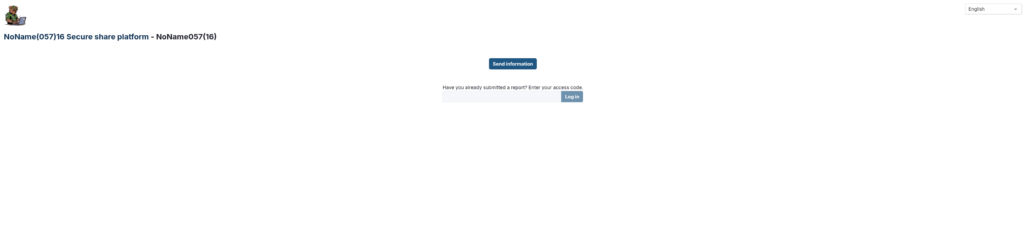
Q (fastfire): What was the purpose of the onion portal (http[:]//op7yiekgumt7po6mjgii4uewrwjydx5vhpa6y5gv7glftmw5srbwnaid[.]onion/) launched in March? Has it been actively used, and what feedback have you received about it from the community?
A (F F): This platform is designed to anonymously obtain sensitive information and other valuable data about countries that are unfriendly to Russia. It brings its own results and thanks to it, we increase the level of security of our informants, which is the basis of our activities.

Q (fastfire): The U.S. Department of Justice has linked your activities to the Russian GRU, effectively declaring NoName a group supported by the Russian government. How much truth is there in this claim?
A (F F): It is strange that they did not connect us with the activities of the KGB or the NKVD. Western intelligence agencies openly lie and detain or accuse people who have absolutely nothing to do with us. On the one hand, it helps us to stay in the shadows and continue our activities, but on the other hand, it is a blatant violation of the generally accepted rights and freedoms of citizens. Although there is nothing surprising here – the ideology of the West has always been built on lies and double standards.
Q (fastfire): Do you have active partnerships with other groups? Do you have a list you can share?
A (F F): We report on all our alliances with other groups in our channel. Separately, we would highlight the Z-pentest grouping. Thanks to our joint cyber attacks, we have begun to cause even greater damage to the economies of unfriendly countries.

Q (fastfire): Are any of your team members also administrators or staff members of hacking forums?
A (F F): There are different people in our community. Our volunteer may be your neighbor or the barista from whom you buy coffee every day. Our people are everywhere.
Q (fastfire): Can you name the operations that, in your opinion, were most successful for NoName056? Which ones didn’t achieve their objectives?
A (F F): The vast majority of our daily attacks can be called successful operations. Especially if you look at what huge budgets European countries spend on conducting intelligence operations against us and on strengthening the protection of their resources. But all these expenses are useless. Our attacks cannot be stopped. Frattasi and Baldoni (note: Both are former directors of ACN, the cybersecurity agency in Italy) were fired because of our activities. It doesn’t matter that they’re lying, that they quit on their own. We have paralyzed the work of transport, banks, and disrupted the holding of elections in different countries. Some government websites were completely redesigned after our attacks, as was the case in Britain and Canada. Our collective attacks on industrial facilities led to accidents and consequences offline.
Q (fastfire): Have you ever asked for a ransom to stop an attack on a target?
A (F F): No, we are not working for monetary gain, we are fighting for our ideology.
Q (fastfire): What kind of agreement would you consider appropriate to end the Russian-Ukrainian conflict?
A (F F): We would prefer peace on Russia’s terms and an international military tribunal, as a result of which all Ukrainian war criminals (starting with Zelensky and those who conducted punitive operations in Donbas since 2014 and burned people alive in the Odessa House of Trade Unions on May 2, 2014) and their accomplices from other countries would face the most severe criminal charges punishment.
Q (fastfire): NoName057 (16) was born when the Russian-Ukrainian conflict began. Will the NoName057(16) project end when that conflict ends?
A (F F): Our group has long gone beyond carrying out attacks on Ukrainian websites. When the special military operation in Ukraine ends (with Russia’s victory, of course), it is unlikely that anything will seriously change in the world of geopolitics. The West will continue to wage wars using its proxies and try in every possible way to destabilize the situation in Russia
如有侵权请联系:admin#unsafe.sh