
Models generate code. Harnesses turn that output into reliable, repeatable, and governable delivery. 2026-7-11 21:38:16 Author: hackernoon.com(查看原文) 阅读量:20 收藏
Models generate code. Harnesses turn that output into reliable, repeatable, and governable delivery.
AI agents create local speed; harness engineering turns that speed into dependable software delivery.
- A harness combines context, skills, tools, permissions, verification, and feedback.
- The goal is not to give agents unlimited autonomy. It is to make correct work easier and unsafe work harder.
- The durable enterprise advantage will be the harness around the model, not the model alone.
AI coding agents can write tests, refactor services, generate infrastructure code, inspect logs, and prepare pull requests. But producing more code is not the same as delivering better software.
That gap matters to leaders. DORA’s recent research has highlighted a recurring reality: individual developer productivity gains do not automatically translate into stronger stability, throughput, or delivery outcomes. AI changes the speed of implementation; it does not remove ambiguity, weak architecture, missing controls, or unclear ownership.
This is where harness engineering becomes essential.
What Is a Harness?
A harness is the operating environment around an AI agent.
It defines what the agent can discover, which tools it can use, what permissions it receives, which workflows it follows, what checks it must pass, and how its outcomes improve the next attempt.
The model is only one component.
A practical harness includes:
- versioned specifications, architecture decisions, and repository guidance;
- reusable skills for recurring engineering work;
- controlled access to code, CI/CD, cloud systems, and observability data;
- tests, linters, policy checks, security scans, and review gates;
- traces and outcome data that convert repeated mistakes into durable improvements.
Harness engineering is the practice of designing an environment that makes correct agent behavior easier, repeatable, and verifiable.
This is not prompt engineering with a new name. A prompt tells an agent what to do once. A harness creates conditions in which good behavior becomes the default.
Figure 1: The Harness Control Loop
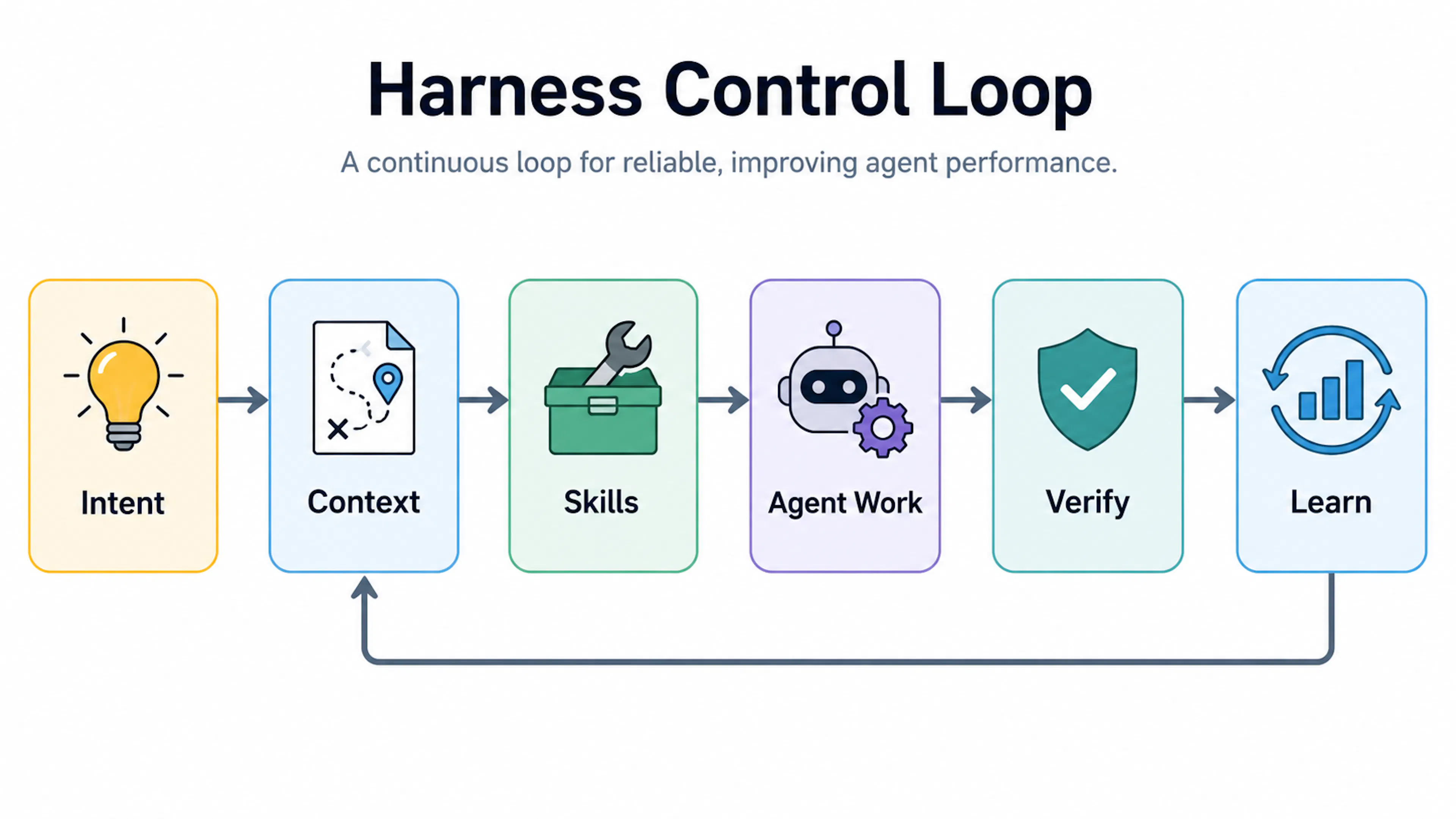 A simple left-to-right flow of Intent, Context, Skills, Agent Work, Verification, and Learning, with learning feeding back into intent and context.
The Five Controls That Make a Harness Work
1. Context: Make the System Legible
Agents cannot use knowledge they cannot find.
Architecture decisions buried in chat threads, outdated wiki pages, and individual engineers’ heads are effectively invisible. The repository should expose service boundaries, ownership, APIs, data contracts, runbooks, constraints, and current plans.
Avoid a thousand-line instruction file. Use a concise entry point that links to structured, versioned sources of truth.
2. Skills: Turn Expert Practice Into Reusable Capability
A skill is more than a reusable prompt. It packages a procedure, relevant context, approved tools, expected evidence, and quality checks.
Useful skills include database migration, API change, dependency upgrade, incident investigation, release readiness, and cloud-cost review.
For example, a migration skill should require compatibility analysis, a rollback plan, migration tests, and observability checks. That turns tribal knowledge into reusable engineering infrastructure.
3. Boundaries: Give Agents Useful but Limited Power
The best agent is not the one with the most permissions. It is the one with the right permissions for the task.
An incident agent may need read-only telemetry access. A code-generation agent may write to a branch but not merge. A deployment agent may prepare a change but require human approval before modifying production.
Harness engineering applies least privilege to agent capabilities, not only to human identities.
4. Verification: Use Deterministic Checks First
Tests, type checking, linting, policy-as-code, security scans, and architecture rules are fast and repeatable. Run them early and on every change.
Use AI review for questions deterministic tools cannot answer: whether the design matches intent, whether documentation explains risk, or whether a proposed change is operationally coherent.
A practical sequence is:
- deterministic checks;
- agent self-correction;
- human review for judgment and accountability.
5. Learning: Convert Repeated Failures Into System Improvements
A recurring agent mistake should not remain a recurring conversation.
If agents repeatedly misuse an API, create a skill or validation rule. If they violate a module boundary, add a structural test. If reviews catch the same deployment risk, improve the release workflow.
Every repeated failure should become a better rule, test, tool, or source of context.
How Developers Can Start
Teams do not need a large agent platform to begin. Start with one high-value workflow:
- adding an API endpoint;
- changing a database schema;
- upgrading a dependency;
- investigating a production incident;
- releasing a feature behind a flag.
For that workflow, define the inputs, permitted tools, required steps, verification checks, expected evidence, and human approval boundary. Then version that workflow beside the code.
The goal is not to automate everything. It is to make one important class of work safer and more repeatable.
Measure Harness Effectiveness, Not Agent Activity
| Metric | What it reveals |
|---|---|
| First-pass verification rate | Whether agent changes pass required checks without major rework |
| Human intervention rate | Where agents still need frequent correction |
| Escaped-defect or rollback rate | Whether speed is creating downstream risk |
| Architecture violation rate | Whether agents preserve system boundaries |
| Time from approved plan to safe merge | Delivery speed without rewarding raw code volume |
| Evidence coverage | Whether changes include tests, risk notes, and validation proof |
| Harness freshness | Whether skills, workflows, and documentation are still current |
Do not use lines of code, number of prompts, or agent pull requests as the primary measure of AI success. Measure whether the delivery system improves.
The Future Beyond Agents
Agents will become more capable and more interchangeable. The lasting enterprise asset will be the harness.
Skills will become versioned organizational capabilities. Workflows will become policy-as-code. Evaluations, traces, and review outcomes will continuously improve the environment in which agents work.
The future is not one autonomous agent replacing a development team. It is a portfolio of bounded agents operating through shared context, trusted skills, controlled tools, measurable workflows, and explicit accountability.
Takeaways
- AI generates code; harnesses create reliable delivery.
- Context, skills, permissions, verification, and feedback are the core layers.
- Treat the repository as an agent-readable system of record.
- Encode repeated failures into tests, rules, skills, and workflows.
- Measure safe delivery outcomes—not activity volume.
- In an agent-first world, the competitive advantage is the system that makes agents dependable.
Suggested Sources
- DORA State of DevOps Report, 2024
- DORA State of AI-Assisted Software Development, 2025
- OpenAI: Harness Engineering in an Agent-First World
- Martin Fowler: Harness Engineering for Coding Agent Users
The Harness Control Loop and the measurement framework are original engineering proposals in this article.
如有侵权请联系:admin#unsafe.sh