
Introduction: Moving Beyond Static MaskingData protection is not a one-size-fits-all problem. When 2026-7-13 02:39:21 Author: hackernoon.com(查看原文) 阅读量:7 收藏
Introduction: Moving Beyond Static Masking
Data protection is not a one-size-fits-all problem. When I first started implementing data redaction, the options were limited. Full redaction replaced everything with zeros or spaces. Partial redaction let you expose some characters and mask others. Random redaction generated unpredictable values. These worked for basic use cases, but they fell short when you needed surgical precision.
Oracle's Data Redaction package, DBMS_REDACT, solves this with regular expression-based redaction. The REGEXP function type lets you search for patterns in your data and replace them with masked values. It gives you control that static masking simply cannot provide.
Let me walk you through what actually works in production. I have used these features in real deployments and can share what to watch out for.
1. The REGEXP Function Type: How It Works
The REGEXP redaction type operates on a search-and-replace model . You define a pattern to search for, and a replacement string. Oracle applies this to query results at runtime. The data on disk remains unchanged. This is dynamic masking, not data transformation.
Setting up a regex redaction policy requires these parameters in the ADD_POLICY procedure :
|
Parameter |
What It Does |
|---|---|
|
|
Set to |
|
|
The regular expression pattern to search for (up to 512 bytes) |
|
|
Replacement string (up to 4000 characters) |
|
|
Starting position for the search (default is 1) |
|
|
0 = replace all occurrences; n = replace nth occurrence |
|
|
Case sensitivity, newline handling, and other matching options |
Here is a simple example :
sql
BEGIN
    DBMS_REDACT.ADD_POLICY(
        object_schema => 'mavis',
        object_name => 'cust_info',
        column_name => 'cc_num',
        policy_name => 'redact_cust_cc_nums',
        function_type => DBMS_REDACT.REGEXP,
        expression => '1=1',
        regexp_pattern => DBMS_REDACT.RE_PATTERN_CC_L6_T4,
        regexp_replace_string => DBMS_REDACT.RE_REDACT_CC_MIDDLE_DIGITS,
        regexp_position => DBMS_REDACT.RE_BEGINNING,
        regexp_occurrence => DBMS_REDACT.RE_FIRST,
        regexp_match_parameter => DBMS_REDACT.RE_CASE_INSENSITIVE,
        policy_description => 'Regular expressions to redact credit card numbers'
    );
END;
/
The result? Credit card numbers like 401288888881881 become 401288XXXXXX1881. The first six and last four digits remain visible. The rest are masked .
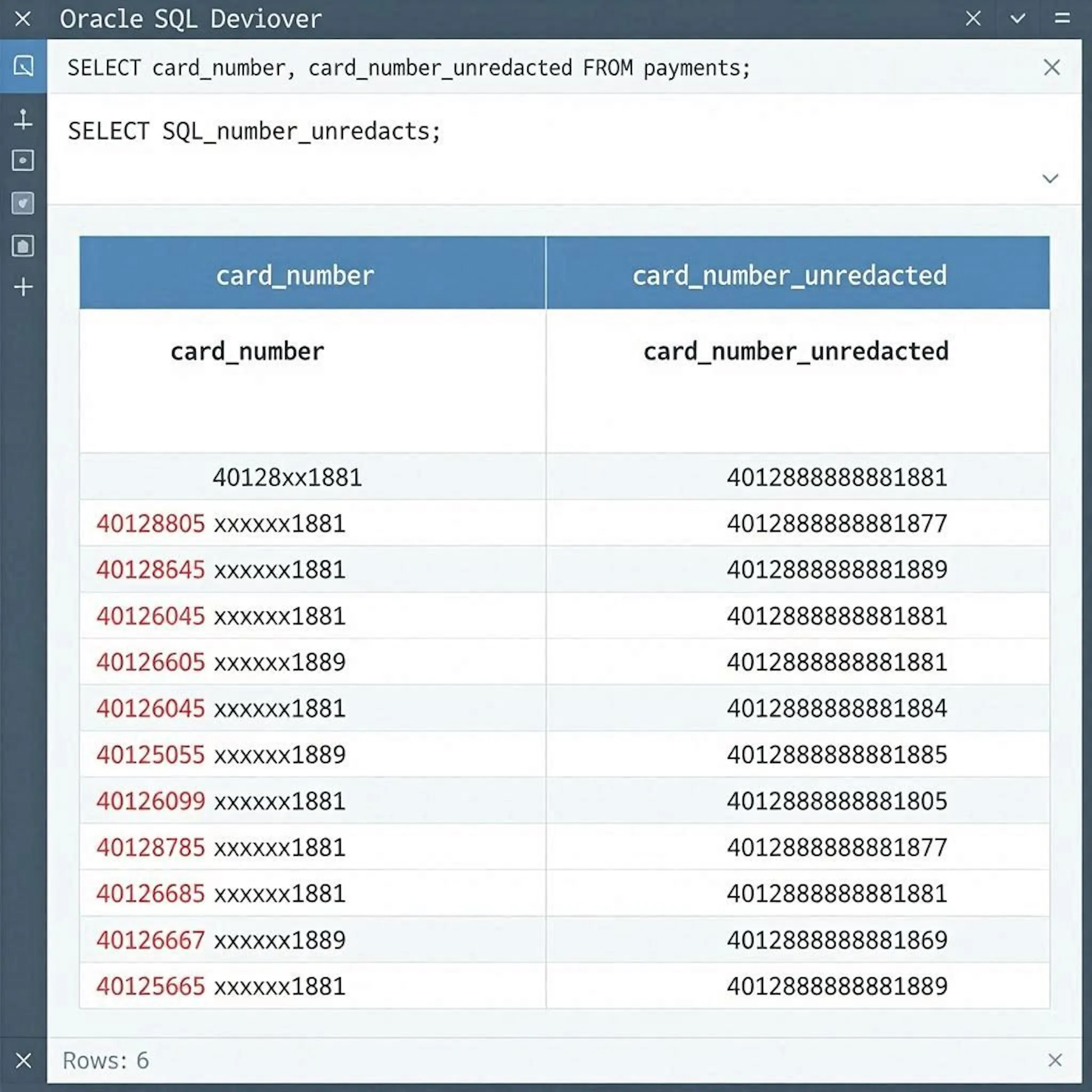 Query result with redacted credit card numbers displayed alongside a regular, unredacted view of the same table
2. Pre-Defined Formats: The Quick Win
Oracle provides pre-defined formats for common sensitive data patterns . These are the fastest way to implement redaction.
Credit Card Formats
|
Format |
Description |
|---|---|
|
|
Credit card numbers (non-Amex) with 6 leading and 4 trailing digits exposed |
|
|
Credit card numbers, redacts all but last 4 digits |
|
|
American Express cards, redacts all but last 5 digits |
Other Common Formats
|
Format |
Description |
|---|---|
|
|
U.S. telephone numbers, redacts last 7 digits |
|
|
Email addresses, can redact name, domain, or entire address |
|
|
IP addresses, redacts last section |
|
|
Any digit, replaces with X or 1 |
These formats are documented and tested by Oracle. I recommend starting with these before building custom patterns .
3. Custom Regex Patterns: When Pre-Defined Is Not Enough
Real-world data rarely matches textbook examples. You might have custom employee IDs, internal reference numbers, or legacy formats. This is where custom regex patterns become essential .
Back-References
The regexp_replace_string parameter supports back-references using the \n format, where n is a number from 1 to 9 . This lets you preserve parts of the matched pattern while redacting others.
For example, a pattern of (\d\d\d) (\d\d\d) (\d\d\d) with a replacement string of XXXXXX\3 would redact 012345678 to XXXXXX678. The third captured group (the final three digits) remains visible .
Pattern Length Limits
The regexp_pattern parameter has a 512-byte limit. I have seen teams waste hours trying to build overly complex patterns that exceed this limit. Keep your patterns focused and test them thoroughly .
Important Safety Mechanism
If your pattern does not match a row, Oracle applies full redaction. This is a safeguard to prevent accidental exposure of sensitive data. Always verify that your pattern matches all values in the column .
4. REGEXP_WIDTH: Compatibility Matters
Oracle provides two regex function types :
|
Function Type |
Behavior |
|---|---|
|
|
No truncation, OCI width attribute becomes 4000 |
|
|
Truncates redacted values to column width, preserves OCI width attribute |
Why does this matter? Some applications rely on the OCI_ATTR_CHAR_SIZE attribute. If you use REGEXP with applications built on Oracle OLE DB Provider, the attribute changes to 4000 and can break your application.
I use REGEXP_WIDTH for production systems unless I am absolutely certain the application layer does not depend on the column width attribute .
5. What Changed in 23ai/26ai
Oracle 23ai/26ai brought significant improvements to Data Redaction. These are not hypothetical. They are real features I have tested .
View-Level Redaction
In older versions, querying a view that referenced a redacted column threw ORA-28094: "SQL construct not supported by data redaction." In 23ai/26ai, views with redacted columns work without errors. The data remains redacted, but the query runs .
Group By and Order By on Redacted Columns
You can now use GROUP BY and ORDER BY on expressions involving redacted columns. This makes reporting much simpler. The data stays protected, but analytical queries work .
Virtual Columns
You can now apply redaction policies to base columns that are part of virtual columns. In older releases, trying to redact a column used in a virtual column expression threw ORA-28073 or ORA-28083. In 23ai/26ai, this works .
Set Operators
UNION, INTERSECT, and MINUS now work with queries that reference redacted columns. Inline views with set operators also execute without errors .
6. The DBA Reality Check
Licensing
Data Redaction is part of the Advanced Security Option, a chargeable Oracle Database option. If you are using Autonomous Database, redaction is available at no extra cost . Make sure you understand your licensing position before implementing.
Performance
Regex redaction adds overhead to query execution. The database must evaluate patterns and apply replacements for every row returned. This is generally acceptable for moderate workloads, but I avoid regex redaction on high-volume OLTP queries.
Fallback Behavior
If regexp_pattern does not match all values, full redaction occurs. This is safe but can surprise users who expected partial masking. Test your patterns on a snapshot of production data.
Conclusion: Surgical Precision for Data Protection
Oracle's regular expression-based redaction gives DBAs surgical control over sensitive data. The pre-defined formats cover most common use cases. Custom patterns handle the outliers. The 23ai/26ai enhancements remove previous limitations around views, group by, and virtual columns.
What matters most is understanding the safety mechanisms. The full redaction fallback protects against accidental exposure. The REGEXP_WIDTH option prevents application compatibility issues. The licensing requirement reminds us that enterprise security comes with a cost.
I have used these features across multiple implementations. They work as advertised. They are not a replacement for proper encryption, but they are an essential tool in any DBA's security toolkit.
References
- Oracle Data Redaction Guide - Regular expression formats and examples
- Oracle PL/SQL Packages Reference - DBMS_REDACT ADD_POLICY parameters
- Oracle Base - Data Redaction enhancements in 23ai/26ai
- Oracle Blogs - Using Data Redaction in Oracle Database 23ai
- DEV Community - Data Redaction and View Enhancements
如有侵权请联系:admin#unsafe.sh