
An excerpt from the book Variable Limits relating to using interaction models to design different 2026-7-13 02:39:15 Author: hackernoon.com(查看原文) 阅读量:9 收藏
An excerpt from the book Variable Limits relating to using interaction models to design different types of Fitness trackers for the medical and consumer industry. Variable Limits is the third book by designer/author The Bauhaus Mouse
Cybernetics, a transdisciplinary model component that consist of communication system, control, information processing and feedback in the exploration of systems in animals and machines. The model aims to connect a cohesive understanding of the living and the mechanical. The brain and body are influenced by interactions with the environment and internal system.
The brain compiles daily perceptions and abstractions stacking on top of each other. In Behavior, Purpose and Teleology, Wiener categorize their essay to evaluate behavioristic study of natural events and to classify behavior, and the importance of purpose. For an object to exist in a space, the behavior of the approach lay in the examination of the output of the object to the surrounding and its relation of the output to the input.
The input is how the event external to the object modifies the object in any manner. Changes in the amount of energy is how behavior affords a basis for classification for active behavior. Active behavior can be classed as purposeful and random. Purposeful behavior can be divided to feedback and non-feedback.
The goal of acting and comparing in a system is distinctive of intelligent systems, in application a person informed of their summary of data analytics changes routine of their performance and habits which vary in all settings.
The model intended for the design of personal trackers will utilize components of Evidence based Medicine (EBM), Complementary and Alternative Medicine (CAM), System theory, Cybernetics and Heidegger's view of the individual and his Dasein.
This Experiential Biology cybernetic model can be described as overall interactions between states, objects, events and message or information with the goal of achieving best form of homeostasis in an entropic environment within an internal or external space.
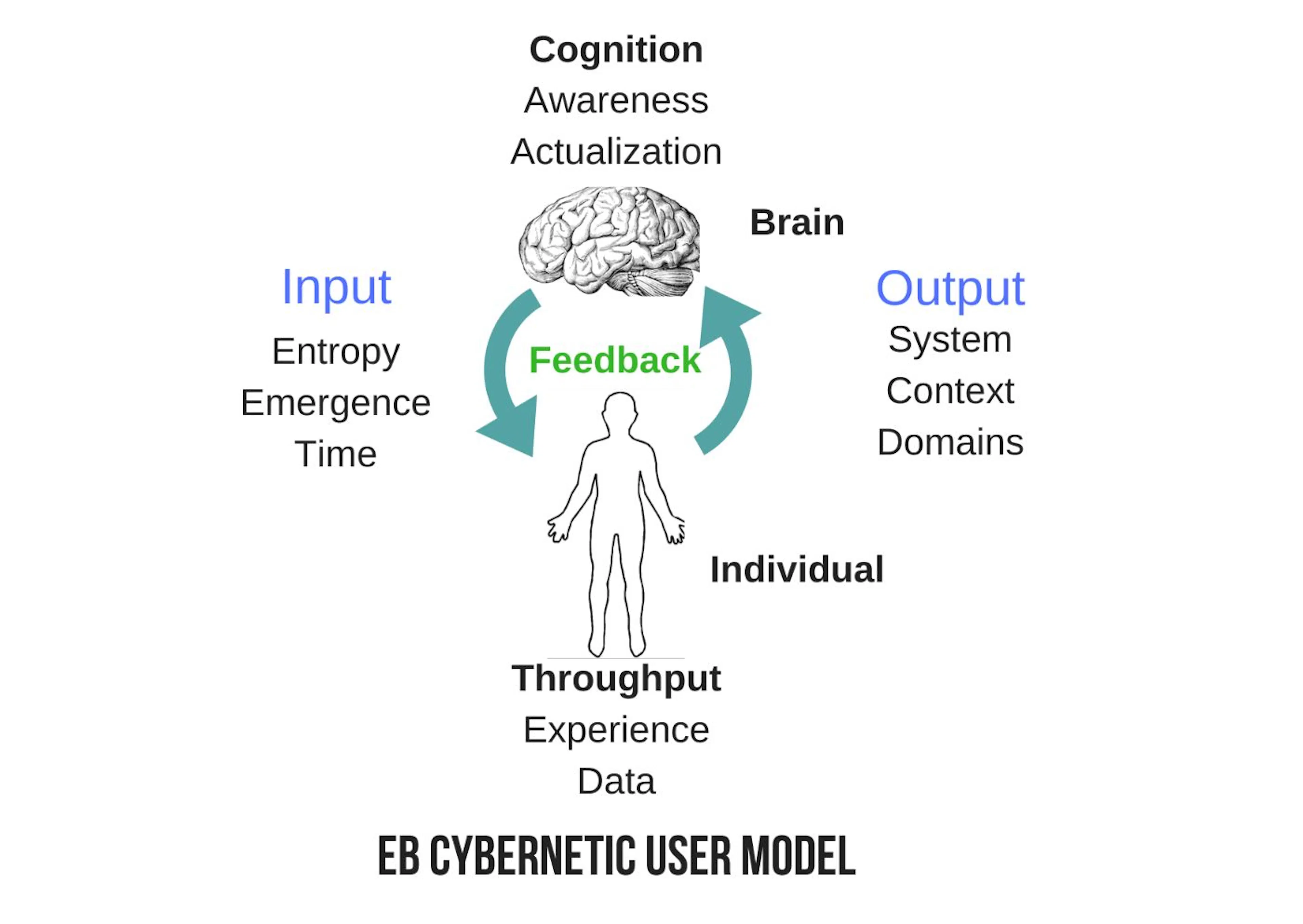
Existence is the pursuit of possibility and facing one's own limitations, Facticity bearing the effects of the past which include gender, genetic inheritance, economic, environment and or cultural artifacts for what is given rather than chosen. Verfallen falling prey to idleness and not being in the world by engagement, the user must know how to act in the present to establish new behaviors or best actions that generate new messages or information which further opens more events or states for the individual to maximize a given potential.
This model is not concerned with social reward rather designed for the individual's continuous learning and generative behaviors that propel continuous usage of the interaction model for new forms of data signatures or messages in relation and interaction whilst coping with dynamic changes.
The individual is a free agent moving in a dynamic environment adopting and maximizing best forms of purposeful behavior with their respective affordance in their Verfallen space. The highest goal of the patient and individual is to transcend the given structure or action cycle to gain the potential of growth, organization and definition.
Time plays a critical role in being able to monitor the events of the system that move from entropic to organization states in the individual as a discrete or continuous value in the form of data or messages across systems. The individual's data form is a mathematical structure of sets, relations and functions existing in a dynamic computation system adherent to the principles of moving from entropic to organization by the patient or individual's ability to act in the Verfallen space for best possible form of purposeful behavior in the context of personal health.
Adopting new behaviors is the interface for the individual's point of contact with a system or environment and the individual's affordance to gain input to drive the data system that constantly undergoes state changes in order to produce optimum outputs.
New behaviors are potential establishing properties of new emergent systems in the individual with new pathways or connections for once again transcending potential structural loops for more levels synergy of the whole is greater than the sum of parts.
Throughput, the ability to utilize new energy in a system. In this case the individual or patient filters through the noise to engage in a purposeful behavior in order to generate new outputs while maintaining homeostasis. Homeostasis is equilibrium or ability to maintain fundamental nature despite input.
Generating new observable outputs is the goal of the patient or individual for the pursuit of differentiation, the process of moving from simple to complex organization in a system for potentiality of growth. Feedback is a form of output reflected back or redirected back into the system as new input. The system receives information, feedback about its performance. Negative feedback is corrective feedback that directs the system back to homeostasis. Positive feedback tells the system it is operating correctly.
如有侵权请联系:admin#unsafe.sh